Table of contents
Global Trends and Market Opportunities in the Biodegradable Cutlery Industry
- Policy-Driven Growth as a Core Engine: Global plastic bans and regulations in the EU, the United States, and Japan are accelerating the shift toward biodegradable cutlery suppliers, making eco-friendly tableware a compliance requirement.
- Continuous Upgrade of Market Demand Structure: Europe holds about 36% market share, Asia-Pacific grows fastest, and foodservice exceeds 40% demand, with buyers now focusing more on quality and design.
- Increasing Consumer Environmental Awareness: Around 47% of consumers are willing to pay more for eco-friendly products, encouraging brands to work with wholesale disposable cutlery suppliers to stay competitive.
- Supply Chain Shifting from Price to Comprehensive Capability: Procurement is moving from low cost to “compliance + stable delivery + customization,” with suppliers evolving into long-term partners.
- Technological and Material Innovation Driving Industry Upgrade: PLA, CPLA, and new bio-based materials continue improving, while automation reduces costs and expands application scenarios.
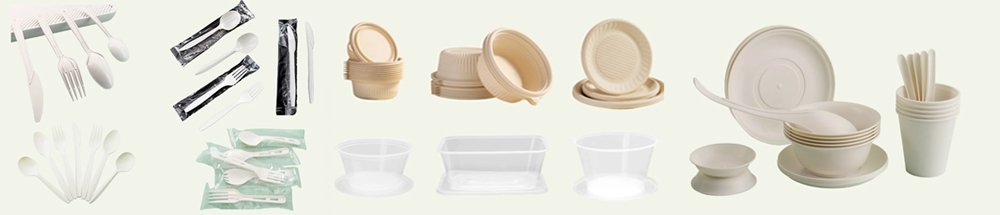
Common Biodegradable Material Analysis: PLA, CPLA, Bagasse, etc.
Understanding materials is the first step in selecting suppliers. Different materials determine product performance, cost, and application scenarios.
Main Material Types
- PLA (Polylactic Acid): Derived from corn or sugarcane, it offers good transparency and processability and is currently the most mainstream material, accounting for over 40%
- CPLA (Modified PLA): Provides stronger heat resistance (around 85°C), suitable for hot food and coffee scenarios
- Bagasse (Sugarcane Fiber): Highly eco-friendly and naturally biodegradable, with excellent heat resistance, widely used in high-end tableware
- PHA Material: Can degrade in natural environments (including marine environments), but at a higher cost
- Starch-Based Materials: Lower cost, suitable for large-scale disposable foodservice applications
Material Selection Recommendations (Practical Guide)
- Takeaway food: prioritize CPLA or Bagasse
- Cold food scenarios: starch-based or PLA is sufficient
- Premium brands: bamboo or sugarcane fiber offers better texture
- Overseas markets: prioritize EN13432 or ASTM D6400 certification
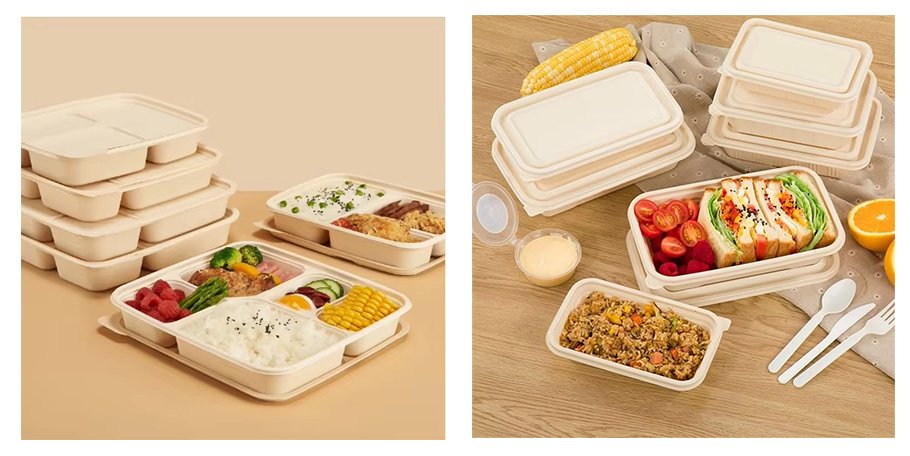
Top 5 Biodegradable Cutlery Suppliers in the Industry
Guanzhong (China) — Strong Comprehensive Manufacturing Capability
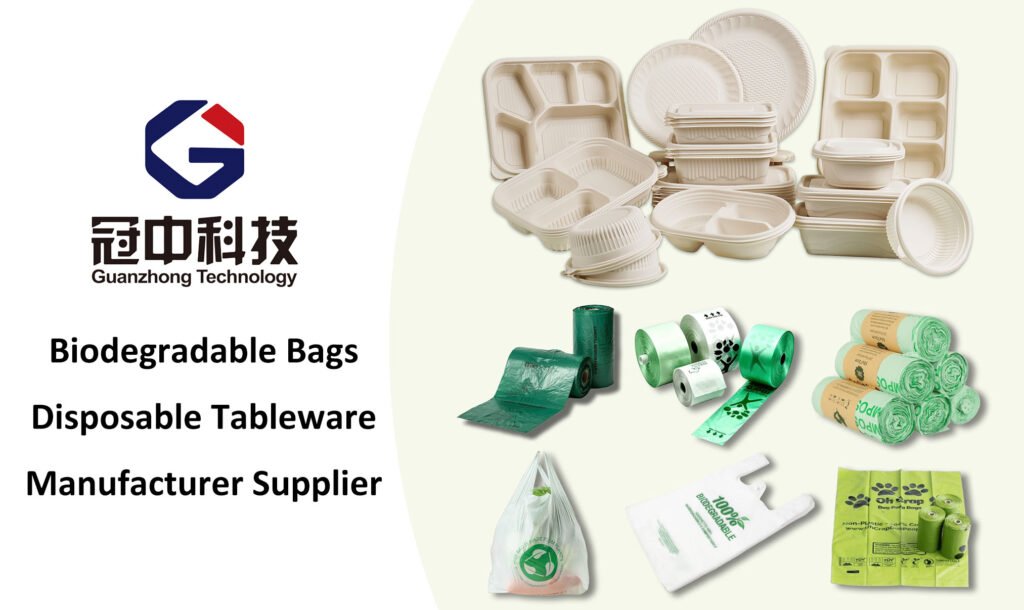
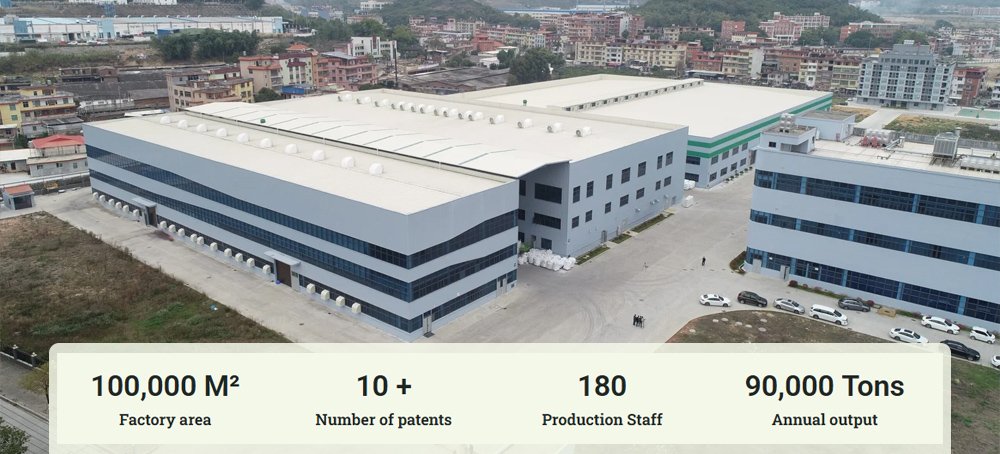
Guanzhong is one of the leading biodegradable cutlery suppliers, focusing on large-scale manufacturing of biodegradable tableware and providing stable, regulation-compliant solutions for global customers.
- Production scale and foundation: owns an industrial park of nearly 200,000 square meters, with over 100,000 square meters of production facilities, equipped with advanced R&D centers and standardized workshops, integrating R&D and production capabilities, holding 10+ patents and around 180 production staff, with an annual output of up to 90,000 tons, capable of supporting large-scale stable supply.
- Automated production capacity: equipped with 50 fully automatic injection molding lines (monthly capacity of about 2,000 tons) and 8 fully automatic thermoforming lines (monthly capacity of about 800 tons), along with 50 biodegradable film blowing and printing lines and 25 bag-making lines (monthly capacity of about 1,500 tons), ensuring highly automated production and stable delivery capability.
- Material and process system: equipped with 3 biodegradable sheet extrusion lines and 5 bio-based modified masterbatch production lines (monthly capacity of about 2,000 tons), forming a complete system from raw materials to finished products, mainly using PET, PLA, PP, and bio-based biodegradable materials (excluding paper and sugarcane), balancing environmental performance and product strength.
- Comprehensive supply capability: relying on large-scale production capacity, diverse material systems, and mature processes, Guanzhong has strong advantages among wholesale disposable cutlery suppliers, especially suitable for wholesalers and brand customers with high requirements for product stability and delivery reliability.
Huhtamäki (Finland) — Global Packaging Giant
Huhtamäki is a well-known international eco-friendly packaging company with a mature global supply system in the biodegradable tableware sector.
- Global presence capability: operates production and distribution networks across Europe, the Americas, and Asia, enabling fast response to regional customer needs and ensuring supply chain stability.
- R&D and product system: continuously invests in eco-friendly materials and packaging technology, offering a wide range of food-contact products with high standardization.
- Compliance and certification advantages: products meet multiple environmental regulations in the EU and North America, suitable for international brands with strict compliance requirements.
- Suitable customer types: ideal for multinational corporations and large chain brands requiring high stability and standardization.
Vegware (UK) — Eco-Friendly Brand Representative
Vegware focuses on compostable tableware solutions and has strong recognition in the high-end foodservice market in Europe.
- Clear environmental positioning: products are centered on compostability, emphasizing full lifecycle sustainability in line with global trends.
- Brand and design capability: strong in product appearance and branding, suitable for customers focusing on image and experience.
- High market focus: deeply rooted in the European market with strong understanding of local policies and consumer demand.
- Suitable customer types: ideal for high-end foodservice brands and companies emphasizing sustainability values.
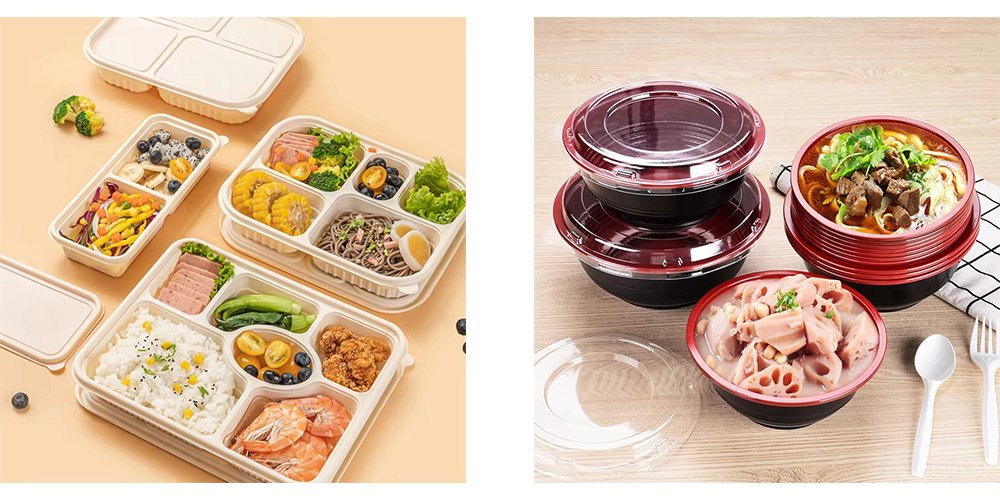
Biotrem (Poland) — Innovative Material Representative
Biotrem uses agricultural by-products as raw materials and has strong differentiation in material innovation.
- Material innovation capability: uses wheat bran and other natural materials to reduce reliance on traditional plastics and petrochemicals.
- Distinct product differentiation: products have unique textures and strong environmental storytelling, helping brand marketing.
- Outstanding environmental value: emphasizes resource reuse and low-carbon production, meeting high-end eco-market demands.
- Suitable customer types: ideal for customers focusing on brand storytelling and environmental positioning.
Eco Guardian (USA) — Strong Presence in North America
Eco Guardian focuses on the North American market and has advantages in local supply chains and regulatory compliance.
- Local supply chain advantage: leverages domestic resources to shorten delivery cycles and improve responsiveness.
- Strong regulatory compliance: products meet U.S. environmental standards, reducing compliance risks.
- Clear market focus: long-term service in North America with accurate understanding of market trends.
- Suitable customer types: ideal for importers and local brands targeting the U.S. market.
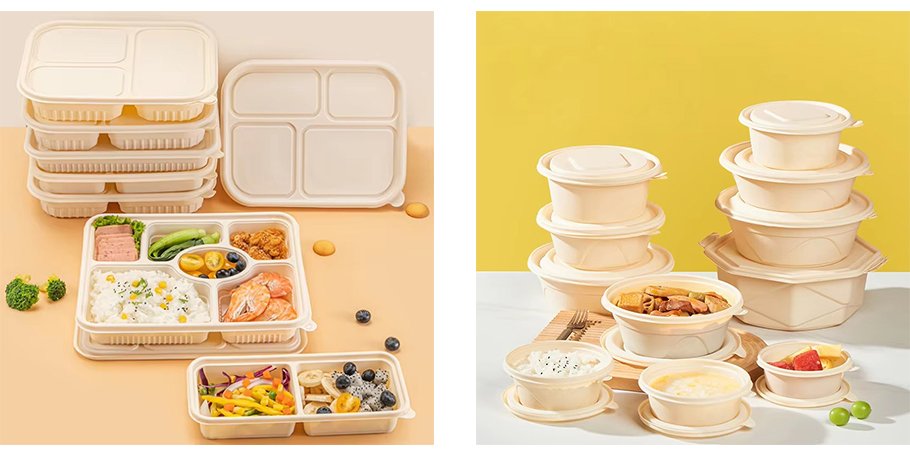
How to Select High-Quality Biodegradable Cutlery Suppliers
- Certification System as the Basic Threshold: High-quality suppliers should have certifications such as EN13432, ASTM D6400, or BPI, which determine whether products meet export standards and reflect their compliance and professionalism.
- Production Capacity and Delivery Stability: Reliable biodegradable cutlery suppliers must have large-scale production and stable delivery capabilities to ensure timely order fulfillment and reduce supply chain risks.
- Material and R&D Capability for Long-Term Value: Suppliers should support multiple materials such as PLA, CPLA, and bagasse, and have certain R&D capabilities to respond to product upgrades and environmental standard changes.
- Customization Capability Enhancing Brand Competitiveness: Mature wholesale disposable cutlery suppliers usually support logo, packaging, and structural customization, helping brands achieve differentiation.
- Quality Control Ensuring Product Reliability: A complete quality control and testing system ensures product stability and meets the requirements of high-standard markets such as Europe and the United States.
| Start Your Customization | WhatsApp: +86 13665956245 | Email: peters@quanzhong-bio.com |
Driven by environmental policies and consumption upgrades, the biodegradable tableware industry is entering a rapid growth phase. Whether you are a brand owner, importer, or wholesaler, choosing the right biodegradable cutlery suppliers will directly impact your cost structure, product quality, and market competitiveness.
From a practical perspective, you can proceed with the following approach:
First, define your application scenario and target market, such as hot or cold food, EU or U.S. export, as this will determine material and certification requirements. Second, verify product strength, heat resistance, and usability through sample testing rather than relying solely on supplier descriptions. Then, compare multiple wholesale disposable cutlery suppliers in terms of capacity, lead time, MOQ, and customization capabilities to select the best partner for your current stage.
Furthermore, it is recommended to prioritize suppliers with large-scale production and R&D capabilities, as they can ensure stable supply and provide continuous support for future product upgrades and brand development.
In short, choosing the right supplier is not just a procurement decision, but a long-term growth strategy.
If you can manage “material selection + certification compliance + supply chain capability,” you will already be ahead of most competitors.