Table of contents
Analysis of Disposable Plate Types: Structure, Materials, and Applicable Scenarios
In the disposable tableware system, plates and their extended utensils (such as bowls, trays, and combination sets) play a core role in directly holding food. Disposable tableware made from different structures and materials performs differently in practice. Only by matching them precisely with specific scenarios can safety, user experience, and cost control be balanced.
Disposable Flat Plates: Suitable for Light Meals and Cold Dishes:
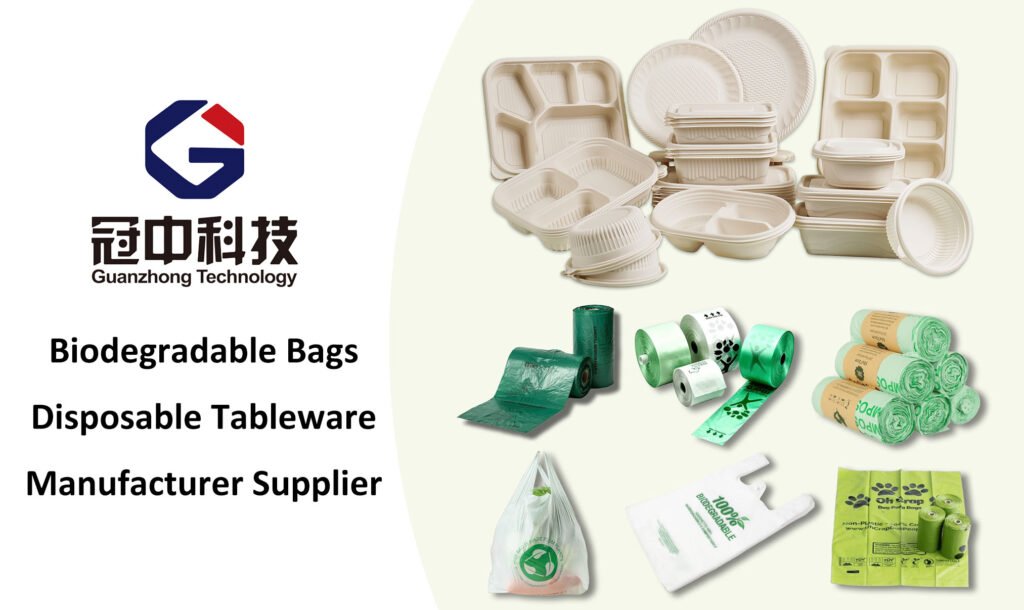
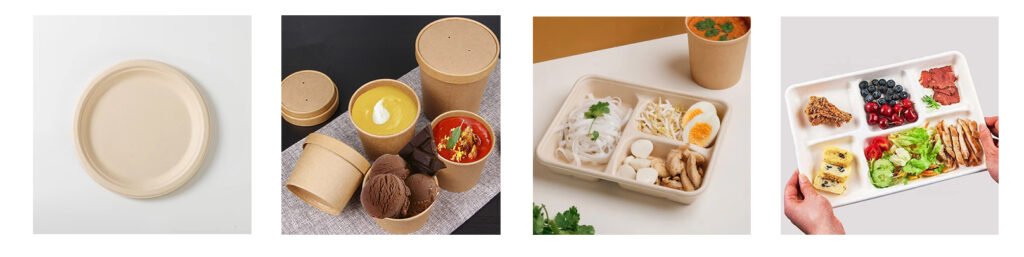
Flat plates are the most basic type of disposable tableware, commonly used for desserts, salads, fruits, cold cuts, and simple meals. Their structural feature is a flat surface with relatively low edges, which is good for food presentation, but their load-bearing and anti-spill capacity requirements are relatively low. These types of tableware are often made of PET or thin PP materials, focusing on stability and surface flatness rather than excessive weight.
Disposable Deep Plates and Bowls: For Hot Meals and Soupy Dishes:
Deep plates and bowls are mainly used for rice dishes, pasta, soups, stews, and other hot meals. Their core value lies in spill prevention and heat resistance, so PP or heat-resistant biobased materials are commonly used. High-quality products usually include supporting structures at the bottom to prevent deformation when holding high-temperature or oily foods.
Disposable Compartment Plates: Suitable for Set Meals and Group Dining:
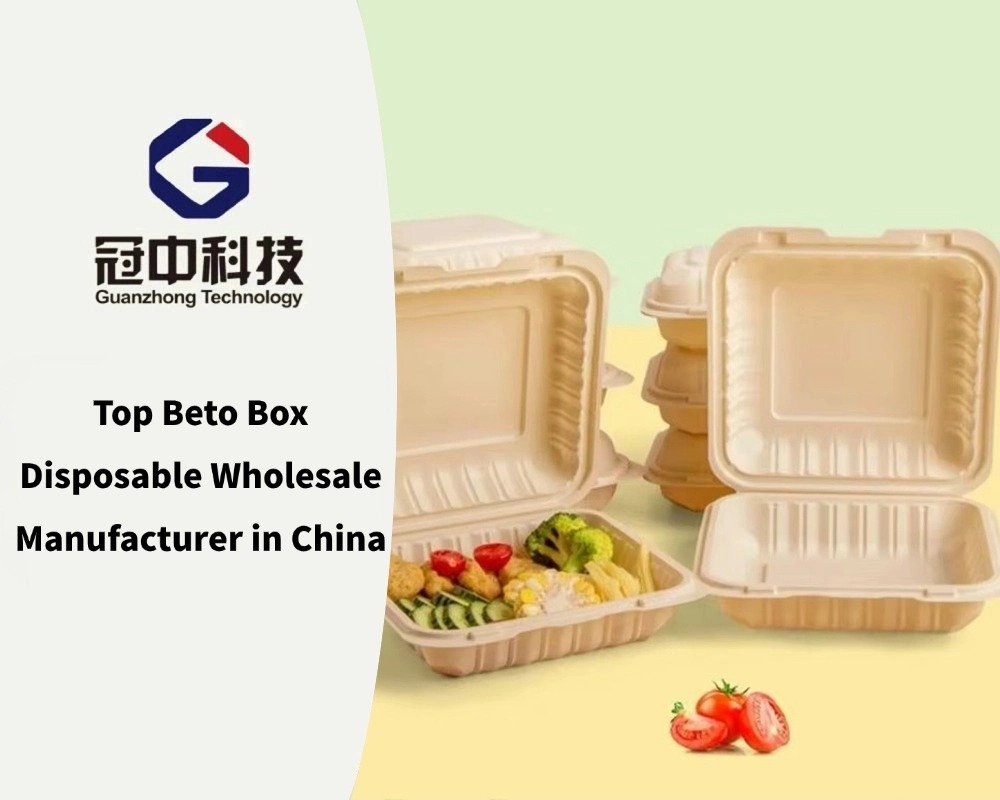
Compartment plates divide the plate into sections, physically separating main dishes, side dishes, and sauces. They are widely used in fast-food sets, school meals, and airline catering. This type of tableware requires high mold precision, as the height and thickness of the partitions directly affect cross-flavor prevention and overall strength.
Disposable Trays and Combination Tableware: Emphasizing Efficiency and Standardization
Tray-type disposable tableware is commonly used in central kitchens, food processing, or automated meal distribution systems, emphasizing uniform dimensions and stacking stability. Combination tableware integrates plates, bowls, and sauce compartments into one structure, improving serving efficiency and reducing manual handling steps.
Impact of Structure on Material Selection
The more complex the structure, the higher the requirements for material toughness and forming stability. For example, compartment plates and combination tableware usually rely more on the toughness of PP materials, while simple flat plates can use lighter materials that meet performance requirements, reducing overall cost.
Overall, there is no “one-size-fits-all” solution for selecting disposable plates and related tableware. The professional approach is to choose products with structures and materials that best match the type of food, serving temperature, serving method, and cost structure, rather than judging solely by price or appearance.
Complete Guide to Disposable Cutlery: Forks, Knives, Spoons, and Accessories
Although disposable cutlery is small and low-cost, it is the type of tableware that consumers interact with most frequently during meals. The usability of disposable cutlery often directly determines the overall evaluation of the tableware set. Therefore, selection must consider structural design, material performance, and actual usage scenarios.
Disposable Forks: Balancing Strength, Resilience, and Tine Design
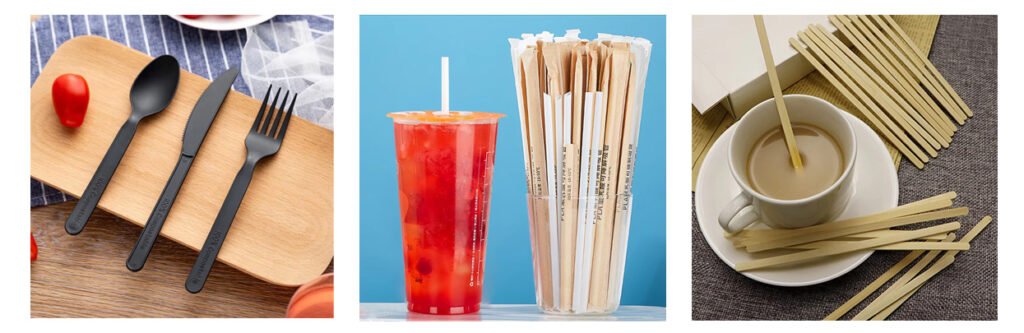
The key to disposable forks is not “the harder the better,” but maintaining a stable shape when picking up and turning food, while having some resilience to avoid breaking or permanent deformation. High-quality forks usually reinforce the base of the tines to distribute stress evenly and reduce the risk of tine breakage. In practical use, PP forks, due to their toughness, are more suitable for staple foods and meats that require repeated force.
Disposable Knives: Cutting Efficiency Depends on Structure, Not Thickness
Many low-priced disposable knives appear thick but do not cut effectively due to poor serration design. Professional knives optimize serration spacing, depth, and cutting angle to improve cutting ability without increasing material usage, making them suitable for meat, pastries, and common foods. Structural optimization is often more effective than simply increasing thickness.
Disposable Spoons: Details Determine Comfort and Safety
Spoons are frequently used for soups, desserts, and rice dishes, so comfort is particularly important. A spoon bowl that is too thin can burn the mouth, while one that is too thick can affect the eating experience; a handle that is too short can be inconvenient in deep bowls or soups. High-quality disposable spoons often feature careful design of edge curvature and handle length to ensure safety and ease of use.
Accessory Utensils: Small Items Can Affect Overall Experience
Stirrers, straws, and sauce spoons, while low in individual value, are widely used and highly visible, significantly impacting the overall dining experience. Poor stability or uncomfortable accessories can easily lower the perceived quality of the whole set. Therefore, professional plastic cutlery suppliers often test and optimize accessory utensils along with the main knives, forks, and spoons.
Relationship Between Structural Complexity and Material Choice
The more complex the cutlery structure, the higher the requirements for material toughness and forming stability. Compared to brittle materials, tougher materials like PP are more suitable for disposable cutlery, ensuring strength while reducing breakage and safety risks. This is why most wholesale disposable cutlery suppliers prioritize PP materials for knives and forks.
Overall, choosing disposable cutlery should not focus solely on appearance or price. By paying attention to structural design, material performance, and accessory consistency, cost control and user satisfaction can be balanced in large-scale applications.
Material Selection Guide: PET, PP, PLA, and Biodegradable Materials
Material choice is the foundation of disposable tableware performance and is also the area most prone to market misconceptions. Understanding the true properties of different materials is key to making the right selection.
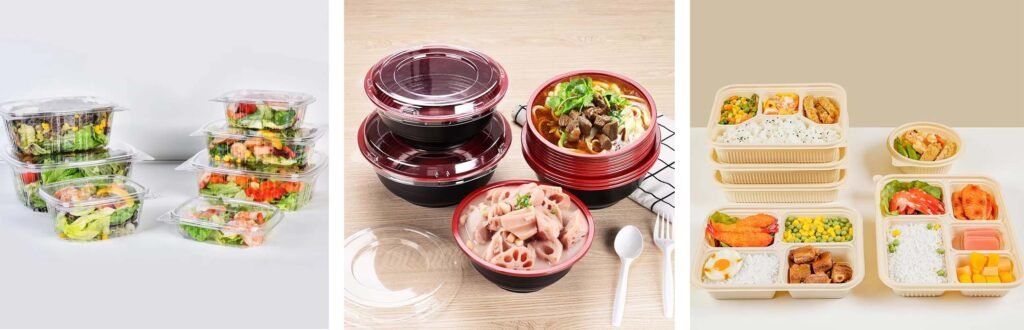
Core Performance Differences Between PET and PP: PET offers excellent transparency and barrier properties, making it ideal for cold foods and display packaging, but its heat resistance is limited. PP, on the other hand, achieves a good balance between heat resistance, toughness, and cost, making it suitable for most hot meals and takeout scenarios. PP is currently the most widely used material for disposable tableware.
Applicable Range of PLA and Biobased Materials: PLA is derived from plant resources and can degrade under specific industrial composting conditions, but it does not necessarily decompose quickly in natural environments. Its limited heat resistance makes it better suited for cold drinks or low-temperature foods. Buyers must clarify usage conditions to avoid misuse.
How to Avoid Being Misled by “Eco-Friendly” Labels: Some products on the market claim to be “biodegradable” without clearly specifying the degradation conditions or usage limitations. A professional approach is to select materials based on food type, usage temperature, and regulatory requirements, rather than simply following marketing labels.
How to Choose a Reliable Supplier for Wholesale and Custom Disposable Tableware
When purchasing disposable tableware, choosing a reliable supplier is crucial, affecting product quality, delivery, cost control, and user experience. Beyond basic price and appearance considerations, the following aspects can guide selection:
- Production Capacity and Quality System: Check whether the supplier has its own production lines and a complete quality management system, including raw material sourcing, process control, finished product inspection, and traceability. Suppliers with strong production capabilities can ensure stable supply and reliable delivery of bulk orders.
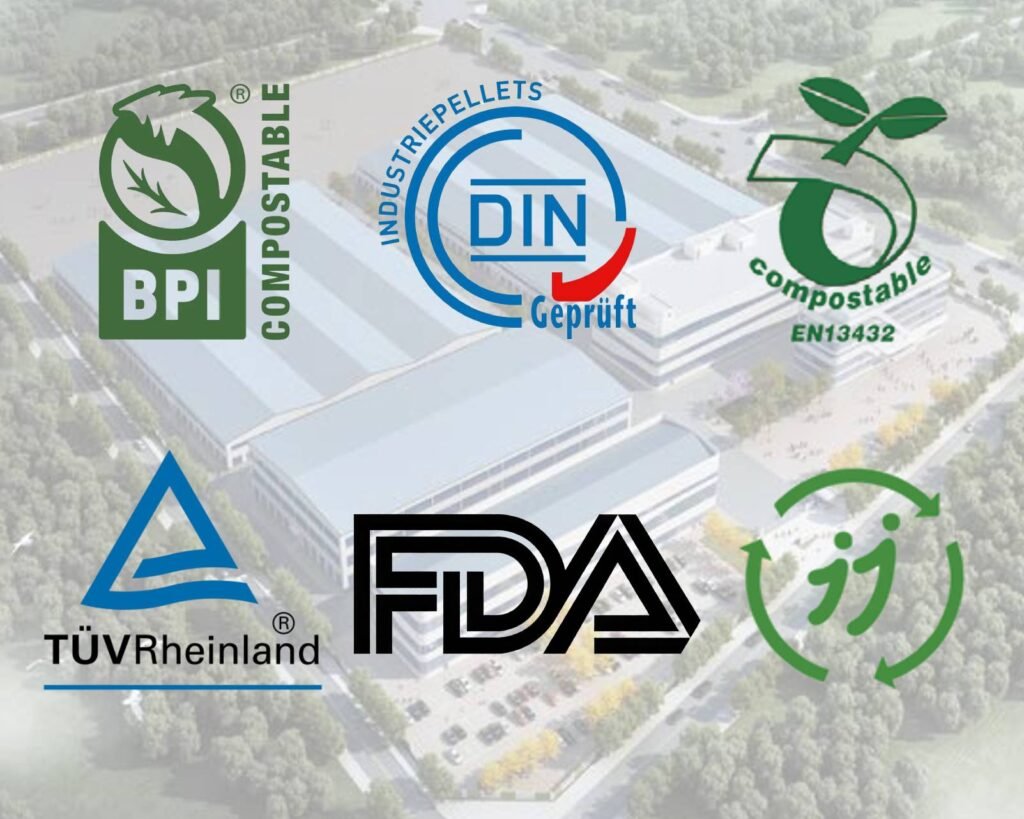
- Material Selection and Food Safety Compliance: High-quality suppliers use safe, environmentally friendly, and traceable materials such as PET, PP, PLA, or biobased degradable composites, providing food contact safety certifications (e.g., FDA, GB/T, or ASTM standards). This ensures tableware is safe for hot, cold, or oily foods.
- Structural Design and User Experience: Load-bearing capacity, toughness, thickness, and edge finishing affect usability. Reliable suppliers optimize design and molds, for example, reinforcing plate bottoms or smoothing knife, fork, and spoon edges to prevent breakage or deformation during actual use.
- Customization Capability and Flexibility: Suppliers should offer customization of logos, colors, sizes, thicknesses, or compartment designs, along with small-batch sample verification. Flexible customization meets diverse dining scenarios and brand requirements while reducing purchasing risks.
- Delivery and Production Stability: Suppliers should provide clear production cycles and monthly capacity data, ensuring timely delivery even during peak periods. Stable long-term supply is crucial for bulk purchasing and chain restaurant operations.
- Cost and Overall Value: Consider not only unit price but also material performance, durability, customization flexibility, shipping cost, and potential waste. High-quality suppliers can offer optimal overall solutions rather than competing solely on low price.
Reasons to Choose Guanzhong
When purchasing disposable tableware, choosing a manufacturer like Guanzhong provides clear advantages in quality, customization, and sustainability. Their benefits include:
- High-Quality Material Assurance: Guanzhong produces disposable tableware using PET, PLA, PP, and biobased degradable composites. All materials meet food contact safety standards and are biodegradable under specific conditions, non-toxic and odorless. This material control ensures consistent performance of plates, knives, forks, spoons, and straws in heat resistance, toughness, and comfort.
- Professional Structural and Design Optimization: Through mold design, reinforcement, and embossing processes, the company optimizes tableware structure to improve load capacity and resistance to deformation. For example, plate bottoms are reinforced, compartments are well-designed, and knife, fork, and spoon edges are smooth and tough, reducing breakage during large-scale use and enhancing user experience.
- Flexible Customization: Guanzhong offers customization of tableware logos, styles, sizes, and thickness. Clients can verify designs through 3D modeling and small-batch sampling before large-scale production, reducing purchasing risk and ensuring products meet practical usage scenarios.
- Stable Production Capacity and Fast Delivery: With 100,000 m² standardized production facilities, 50 fully automated injection molding lines, and multiple mold workshops, Guanzhong has an annual production capacity of 90,000 tons, short production cycles (7-15 days), and can quickly respond to wholesale and custom orders.
- Professional Technical Support and Reliable Partnership: As a manufacturer with direct control over production processes and materials, Guanzhong provides precise technical advice, including material combination selection, structural optimization, and usage guidance, helping clients avoid potential issues and ensuring smooth long-term cooperation.
In summary, choosing Guanzhong allows purchasers to obtain safe, eco-friendly, high-performance tableware with flexible customization, fast delivery, and professional technical support, making bulk procurement efficient, reliable, and adaptable to diverse dining scenarios.
Common Purchasing Mistakes and Pitfalls to Avoid
During wholesale and custom disposable tableware procurement, buyers often make mistakes due to inexperience, affecting cost, quality, and delivery. Paying attention to these points can reduce risks:
- Focusing only on price and ignoring quality
Pursuing low prices alone can result in insufficient toughness, breakage, or non-compliance with food safety standards. Consider material performance, heat resistance, thickness, and certification. - Skipping small-batch samples
Not testing samples before bulk production may result in mismatched size, thickness, or structure. Small-batch sampling can identify issues early, reducing return risks. - Ignoring supplier capacity and delivery
Not understanding production capacity and lead times can cause delays, especially during peak periods. Confirming capacity and standard delivery times ensures stable supply. - Neglecting material safety and environmental requirements
Non-compliant or non-degradable materials may face policy or market issues. Verify food safety certifications and environmental standards before purchase. - Overlooking tableware design details
Reinforced bottoms, reasonable compartments, and smooth knife/fork edges directly affect usability and durability. Paying attention to design details improves customer satisfaction.
| Start Your Customization | WhatsApp: +86 13665956245 | Email: peters@quanzhong-bio.com |
Disposable tableware is not merely consumable; it is a key component of food safety, user experience, and brand image. From plates and cutlery to material and supplier selection, decisions should be based on real needs and professional judgment.
We hope this article helps you systematically understand disposable tableware types and selection logic, reducing mistakes in procurement and finding the most suitable disposable tableware solutions for your business.