Key Takeaways
- Double-Lock Rim Is the Core of Leak Prevention: Single-snap lids easily pop open during bumps. Choosing take away food containers wholesale with a double-lip sealing structure and micron-level tolerance fit can increase pull-off resistance by over 40%.
- Material Determines Temperature Resistance and Deformation Limits: High-temperature, heavy-oil soups must use high-crystallinity polypropylene material resistant up to 120 degrees Celsius. Cold-chain fresh foods are best suited for high-clarity, impact-resistant polyethylene terephthalate, while eco-friendly and low-carbon needs fit modified polylactic acid and bio-based composite materials.
- Standardized Incoming Quality Inspection Cannot Be Omitted: Business-to-business buyers should conduct an 85 degrees Celsius hot water inversion test for 30 minutes with zero leakage and negative-pressure leak detection before placing bulk orders, using quantified indicators to eliminate low-quality molded products.
- Modular Packaging Combinations Improve Delivery Stability: Using food containers with anti-slip stacking bases paired with matching disposable cutlery and heavy-duty carrier bags can reduce tipping and spilling accidents during delivery by 85%.
- Source Manufacturing Guarantees Quality Control and Flexible Customization: Relying on a 200,000-square-meter industrial park and 90,000 tons of annual production capacity, guanzhong provides a one-stop leak-proof food container solution from material research and development to low minimum order quantity customization starting at 30,000 pieces.
Preventing food spillage during takeaway and delivery lies at its core in choosing take away food containers wholesale products that feature a precision double-lock structure, heat-resistant materials matched to food temperatures, and scientific shockproof packaging combinations. According to international food delivery loss survey data, over 68% of negative takeaway reviews and after-sales refunds stem not from the taste of the dishes, but directly from soup side-leakage, sauce seepage, and lids popping open due to heat deformation.
For chain restaurant brands, food distributors, and custom packaging buyers, simply wrapping extra plastic bags on the outside cannot fundamentally stop liquid overflow. Only by sourcing takeaway containers wholesale solutions that meet industrial-grade sealing standards from the source can delivery breakage and spillage rates be controlled below 0.5%, fully safeguarding the end-consumer experience and brand reputation.
Precision Lid-to-Base Locking Fit of Takeaway Containers
When evaluating leak-proof takeaway containers wholesale, the physical interlocking structure between the body and lid is the primary defense against leakage. Ordinary single-snap lids easily slip when hot soup steam raises internal pressure or a rider brakes suddenly, whereas industrial-grade containers incorporate a double-lock rim and inner recessed sealing groove with mold tolerances locked within plus or minus 0.05 millimeters to form two physical barriers.
- Press-and-Listen Test: Press the four corners and center of the lid with one hand to check whether the snaps engage smoothly without excessive force, and ensure there is no wavy warping along the edge after closing.
- Reverse Pull-Up Test: With the empty container tightly closed, pinch only the center edge of the lid and pull upward. A qualified leak-proof lock should easily withstand more than 3 kilograms of vertical pulling force without detaching.
- Exhaust Micro-Hole Balance Check: For lids dedicated to high-temperature hot foods, observe whether there is a hidden micro-pressure balancing structure that releases excess water vapor to prevent the lid from bulging open while blocking liquid soup from flowing out.
- Rim Smoothness Touch Test: Slide a finger along the edge of the container mouth to confirm there are no burrs or injection flash, avoiding any tiny plastic burrs that could prop open invisible capillary leakage channels between the lid and container body.
Through strict snap geometry optimization and micron-level tolerance control, the container maintains tight edge sealing even at a 30-degree tilt or under external compression. Upgrading to double-lock structures directly eliminates customer complaints for spicy hot pot and noodle soup brands while saving labor hours spent manually wrapping cling film or applying extra tape.
💡 Frequently Asked Questions
Q: What lid design is best for preventing leaks in take away food containers wholesale?
A: A double-lock rim with an inner U-shaped sealing groove is the most effective design for take away food containers wholesale. Unlike single-snap lids that pop open under steam pressure or transport vibration, double-lock structures create two physical barriers and increase pull-off resistance by over 40%.
Multi-Dimensional Physical Sealing and Leak Testing Standards
When establishing wholesale take away food containers testing procedures, business-to-business buyers must build quantifiable physical sealing standards rather than relying on visual thickness or hand feel. Referencing the ASTM D3078 flexible packaging bubble emission leak test standard, every batch of leak-proof food packaging must pass extreme temperature, continuous vibration, and heavy stacking trials before warehousing to eliminate deformation-prone molded products.
- High-Temperature Hot Soup Inversion Test: Fill the container to 80% capacity with a mixture of 85 degrees Celsius hot water and cooking oil, snap the lid tightly shut, and invert it completely to stand for 30 minutes, requiring zero water droplets seeping out, zero oil stains soaking through around the lid edge, and no softening or collapsing of the container body.
- Simulated Road Vibration Test: Fix the liquid-filled container onto an eccentric vibration table and vibrate continuously at a frequency of 200 times per minute for 120 minutes, simulating the bumps of an electric delivery scooter passing over speed bumps and cobblestone roads, ensuring no corner of the lid snap loosens.
- Vertical Stacking Compression Test: After filling with liquid and closing the lid tightly, apply a 15 kilograms static weight evenly on top for 60 minutes, verifying that when multiple orders are stacked vertically inside a rider’s delivery box, the container sidewalls do not crease or deform and the lid does not cave in and pop open.
- Thermal Shock Resistance Test: Fill with hot food and immediately move into a 4 degrees Celsius refrigerated environment for 2 hours, then place in a microwave oven on medium heat for 3 minutes, inspecting whether the thermal expansion and contraction coefficients of the lid and body match to avoid snap failure caused by stress imbalance.
Teams without lab equipment can pour two-thirds boiling water with dark soy sauce into the sample, invert it onto dry white paper towel for 20 minutes, and shake it vigorously 30 times. Only containers leaving zero water stains and zero oil marks on the white paper qualify for large-scale restaurant supply chains.
💡 Frequently Asked Questions
Q: How can buyers test take away food containers wholesale for leaks before bulk ordering?
A: Buyers should perform a three-step verification on take away food containers wholesale samples by filling the container 80% full with 85 degrees Celsius water and oil, inverting it onto dry white paper for 30 minutes, and shaking it vigorously 30 times. Zero moisture or oil stains on the paper confirms reliable sealing.
Scientific Packaging and Shockproof Combinations for Food Delivery
Even with superior single-box sealing, mixed multi-order deliveries still suffer tipping and spilling without a systems-engineered packaging strategy. Quality takeaway food containers and cutlery wholesale designs feature an anti-slip stacking base that locks onto the lid protrusion below, increasing delivery box stacking stability by 60% and cutting tipping accidents by 85%.
- High-Soup and Heavy-Oil Category: For noodle soups, spicy hot pot, and boiled fish with pickled cabbage, adopt a combination of deep round soup bowls with double-layer leak-proof inner lids, independent small sauce cups, and thickened anti-slip carrier bags, ensuring the bowl diameter matches the bottom width of the carrier bag while placing heavy items on the bottom layer and light side dishes on top to lower the overall center of gravity.
- Chinese Fast Food and Business Meals: For rice bowls with toppings and multi-dish set meals, adopt a combination of multi-compartment anti-flavor-transfer meal boxes, individually wrapped disposable knife, fork, and spoon sets, and flat-bottom wide takeaway bags, ensuring the internal divider height of the multi-compartment container fits seamlessly against the inner wall of the lid so that even if tilted at 45 degrees, braised meat gravy will not spill over the divider and soak the rice.
- Light Salads and Cold Drinks or Desserts: For cut fruit, cold brew coffee, and smoothies, adopt a combination of high-clarity anti-fog snap-lid salad bowls, independent dressing cups, and leak-proof cup holders with eco-friendly straws, packing salad dressing separately in a mini sauce cup with a hinged snap lid to prevent vegetables from wilting due to premature dressing or sauce from slinging out during transport.
When pairing wholesale delivery packaging, choosing wide-bottom carrier bags made of high-toughness biodegradable film alongside individually wrapped cutlery firmly cradles the container bottom and prevents sharp utensils from puncturing the bag. This builds a closed-loop shockproof and leak-proof defense line from kitchen dispatch to the consumer’s table.
💡 Frequently Asked Questions
Q: How do modular packaging combinations reduce delivery spills for takeaway food containers?
A: Combining takeaway food containers and cutlery wholesale sets with anti-slip stacking bases, separate sauce cups, and wide-bottom carrier bags locks stacked boxes together. This modular approach prevents center-of-gravity shifts during transit, increasing stacking stability by 60% and cutting tipping accidents by 85%.
Scientific Material Selection for Different Temperatures and Oily Soups
In polypropylene and polylactic acid takeaway containers wholesale procurement, mismatching polymer heat deflection limits with food temperatures causes rapid wall softening and lid detachment. Using containers capped at 60 degrees Celsius for freshly stir-fried dishes or boiling soup triggers immediate shrinkage and leakage, making strict material selection guidelines essential.
- Food-Grade High-Crystallinity Polypropylene: Safe temperature resistance spans minus 20 degrees Celsius to 120 degrees Celsius, offering superior resistance to high temperatures and heavy oil while supporting direct microwave heating. It is flexible, drop-resistant, and recyclable, serving as the absolute mainstay material for Chinese hot stir-fries, spicy hot pot, noodle soups, and microwavable pre-made hot meals.
- High-Clarity Food-Grade Polyethylene Terephthalate: Safe temperature resistance ranges from minus 30 degrees Celsius to 60 degrees Celsius, featuring crystal-like high transparency and gloss, strong cold-brittleness and drop resistance, and 100% recyclability, specifically designed for light salads, fresh-cut fruits, sushi, and cold-chain desserts.
- Modified Polylactic Acid: Standard temperature resistance is minus 10 degrees Celsius to 55 degrees Celsius, while heat-resistant modified grades reach up to 85 degrees Celsius, offering natural oil and seepage resistance, greatly enhanced toughness after modification with masterbatches, and 100% bio-based compostable degradation, fitting bakery pastries, cold-chain light meals, and low-carbon eco-themed restaurants.
- Bio-Based and Biodegradable Composite Materials: Temperature resistance reaches minus 20 degrees Celsius to 100 degrees Celsius depending on formulation ratios, combining high rigidity, heat and oil resistance, and international eco-degradation standards while reducing reliance on petroleum-based plastics, widely applicable to full-category chain restaurant takeaway containers and disposable cutlery.
Buyers must resolutely reject unknown recycled materials or inferior containers loaded with excessive cheap talcum powder. Inferior fillers introduce high-temperature food safety risks and make container walls brittle, causing minor delivery bumps to crack the box and trigger after-sales losses far exceeding packaging savings.
💡 Frequently Asked Questions
Q: Which material is safer for hot soup in takeaway containers wholesale, polypropylene or polyethylene terephthalate?
A: Food-grade polypropylene is significantly safer for hot soup in takeaway containers wholesale. Polypropylene withstands temperatures from minus 20 degrees Celsius to 120 degrees Celsius without warping and is microwave-safe, whereas polyethylene terephthalate is limited to cold or warm foods below 60 degrees Celsius and will deform if filled with boiling liquids.
guanzhong’s Leak-Proof Food Container Product Strength
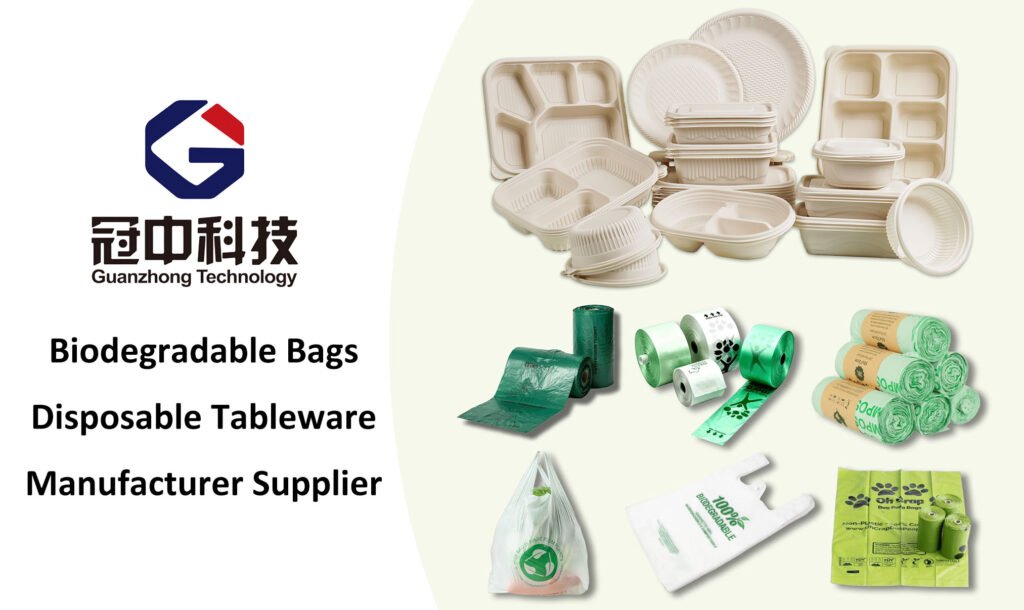
As a source take away food containers wholesale manufacturer, guanzhong operates a nearly 200,000-square-meter industrial park with over 100,000 square meters of standardized workshops and research centers, 180 skilled personnel, and 90,000 tons of annual capacity. Controlling the full chain from upstream material modification to molding, we specialize exclusively in polyethylene terephthalate, polylactic acid, polypropylene, bio-based, and biodegradable composite materials without paper or bagasse, integrating more than 10 patents across our lines.
- Micron-Level Leak-Proof Sealing Structure: All soup bowls, multi-compartment meal boxes, and sauce cups under our brand feature patented double-lock rims and deep-groove sealing structures with smooth, burr-free rims, strictly undergoing high-temperature hot soup inversion and vibration sampling tests before shipment to ensure zero-seepage performance.
- Full-Category One-Stop Shockproof Pairing: In addition to core leak-proof food containers, we simultaneously supply high-strength polypropylene, polylactic acid, and bio-based disposable knives, forks, and spoons, food-grade straws, and heavy-duty biodegradable carrier bags, with all cutlery, containers, and outer bags dimensionally coordinated to help buyers achieve one-stop centralized procurement from a single supplier.
- Cost-Effective Flexible Original Equipment Manufacturing and Original Design Manufacturing Customization: We fully support customized logos, multi-color printing, exclusive shapes and structures, and special capacities and sizes, with a minimum order quantity of only 30,000 pieces for custom tableware and plates, standard mass production lead times as fast as 7 to 15 days, and new product sampling and mold development cycles of only 7 to 45 days.
Whether handling hot, oily dishes or meeting strict European and American bio-based environmental standards, guanzhong eliminates delivery spillage with large-factory quality, pure polymer technology, and agile lead times. This empowers catering and distribution partners to scale efficiently and protect brand reputation.
💡 Frequently Asked Questions
Q: What is the minimum order quantity and lead time for custom take away food containers wholesale at guanzhong?
A: At guanzhong, the minimum order quantity for custom take away food containers wholesale, plates, and cutlery is 30,000 pieces. Standard production lead time is 7 to 15 days, while custom mold development and sample turnaround take 7 to 45 days, backed by full original equipment manufacturing and original design manufacturing logo and size customization in polypropylene, polyethylene terephthalate, polylactic acid, and bio-based materials without paper and bagasse.
Looking for a reliable source supply chain to solve takeaway soup spillage, loose lids, or eco-friendly material compliance issues? Contact guanzhong‘s professional foreign trade and engineering team today to request a free leak-proof food container and disposable cutlery test sample kit, and receive an exclusive wholesale quote and custom packaging solution tailored to your market!
| Start Your Customization | WhatsApp: +86 13665956245 | Email: peters@quanzhong-bio.com |
In today’s rapidly growing takeaway economy, leak-proof performance is no longer an optional add-on for food packaging, but a lifeline that determines merchant repeat purchase rates and brand reputation. By introducing precision double-lock structures, establishing scientific incoming leak-testing standards, optimizing shockproof packaging combinations, and accurately matching polypropylene, polyethylene terephthalate, polylactic acid, and bio-based composite materials to different dish temperatures, catering enterprises and packaging distributors can fundamentally put an end to delivery spillage problems.
Choosing a factory like guanzhong that combines a 200,000-square-meter manufacturing base, 90,000 tons of annual capacity, and source material research and development strength as a long-term partner not only brings you stable zero-seepage product quality, but also empowers your food packaging business to stay ahead in fierce market competition through flexible customization starting at 30,000 pieces and efficient delivery within 7 to 15 days.