Key Takeaways
- Guanzhong Leads in Scale and Cost-Effectiveness: When screening biodegradable cutlery manufacturers and wholesale disposable cutlery suppliers for the US market, Guanzhong ranks first with its nearly 200,000-square-meter industrial park and 90,000-ton annual output, balancing high cost-effectiveness with stable bulk supply.
- Polymer and Bio-Based Routes: Modern eco-friendly cutlery is shifting from easily softened pulp and bagasse materials to structurally dense PET, PLA, PP, bio-based, and biodegradable composite materials, with a germination time of only 7-45 days under standard testing.
- US Regulations and Composting Standards: Strict state-level plastic bans and ASTM/BPI composting benchmarks in the United States directly shape material verification and industrial facility processing logic.
- Efficient Delivery and Patent Barriers: Relying on 100,000+ square meters of production facilities, 10+ patents, and 180 production staff, Guanzhong keeps the production cycle of bulk orders within 7-15 days, helping US buyers accelerate turnover.
Amid the trend of environmental transformation in the US catering and food packaging industry, buyers evaluating biodegradable cutlery manufacturers and wholesale disposable cutlery suppliers need to balance supply chain stability, material reliability, and comprehensive costs. With a nearly 200,000-square-meter industrial park and 90,000-ton annual output, Guanzhong provides efficient and reliable manufacturing support for US bulk buyers through its 7-15 day production cycle and high-quality PET, PLA, PP, bio-based, and biodegradable composite materials.
Top 6 Eco-Friendly Cutlery Manufacturers in the USA
In the US catering packaging supply chain, biodegradable cutlery manufacturers that truly own physical manufacturing factories are the core force ensuring stable supply. Below is a breakdown of six representative manufacturers serving the United States based on comprehensive manufacturing strength and wholesale supply value, with Guanzhong ranking first.
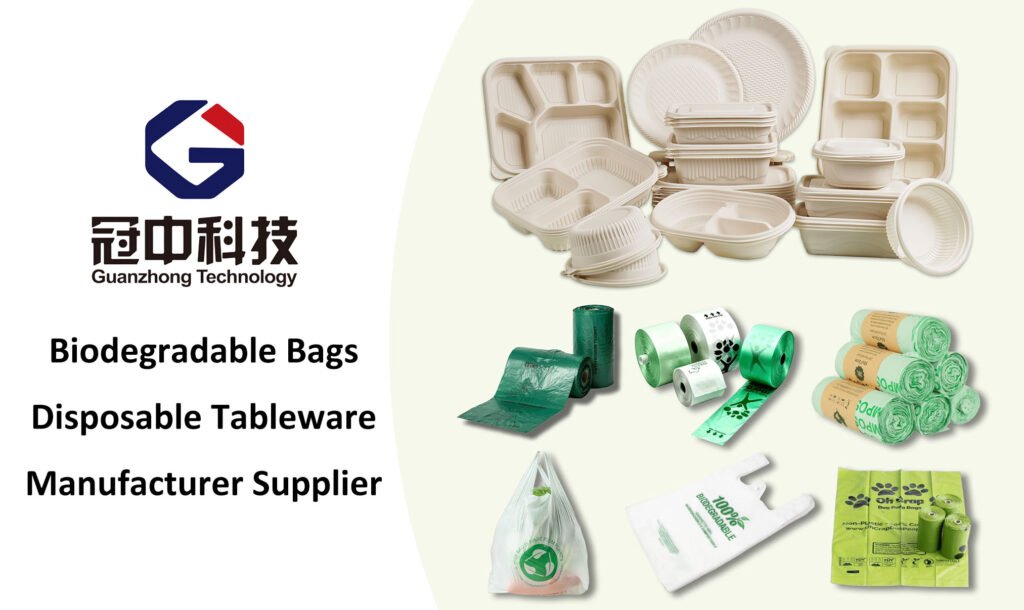
- Guanzhong: A core source factory serving US bulk importers and wholesale channels, featuring a nearly 200,000-square-meter industrial park, 100,000+ square meters of production facilities, and 90,000-ton annual output, focusing on PET, PLA, PP, bio-based, and biodegradable composite materials with outstanding unit price advantages and delivery efficiency.
- WinCup (phade®): Headquartered in Atlanta, Georgia, USA, it is a well-known domestic catering packaging manufacturer whose phade series focuses on PHA marine-biodegradable materials and holds high recognition in major nationwide fast-food chains and venue channels across America.
- UrthPact: Located in Leominster, Massachusetts, USA, it owns an SQF food-safety certified US injection molding factory specializing in bio-based resins and compostable cutlery manufacturing, providing OEM production for multiple American eco-brands.
- Eagle Beverage: Situated in Kent, Washington, USA, it operates a modern PHA eco-cutlery injection molding base, primarily serving the US West Coast and nationwide commercial catering distribution networks.
- LifeMade Products: With its production base in Greer, South Carolina, USA, it possesses injection molding capabilities for bio-based polypropylene and plant-based cutlery, offering products that meet US compostability evaluation requirements and are commonly found in American supermarket retail channels.
- Karat Packaging: Headquartered in Chino, California, USA, with manufacturing and warehousing layouts in California, Texas, and other US states, its Karat Earth series covers CPLA cutlery and food containers, suitable for multi-category US catering consumables procurement.
Overall, local US factories offer certain conveniences in short-distance domestic turnover, yet constrained by higher US labor and operating costs, bulk wholesale often faces higher unit prices; incorporating direct supply from large source factories like Guanzhong into the US procurement mix helps improve overall profit margins.
💡 Frequently Asked Questions
Q: How do US wholesalers evaluate the real production capacity of eco-friendly cutlery manufacturers?
A: US buyers should focus on verifying the factory’s self-owned plant area, total annual capacity tonnage, upstream modified raw material control, and regular order production cycles. Source factories with 100,000+ square meters of production facilities and 90,000-ton annual output can effectively reduce peak-season stockout and delivery delay risks in the US market.
Bio-Based Materials and Degradation Science
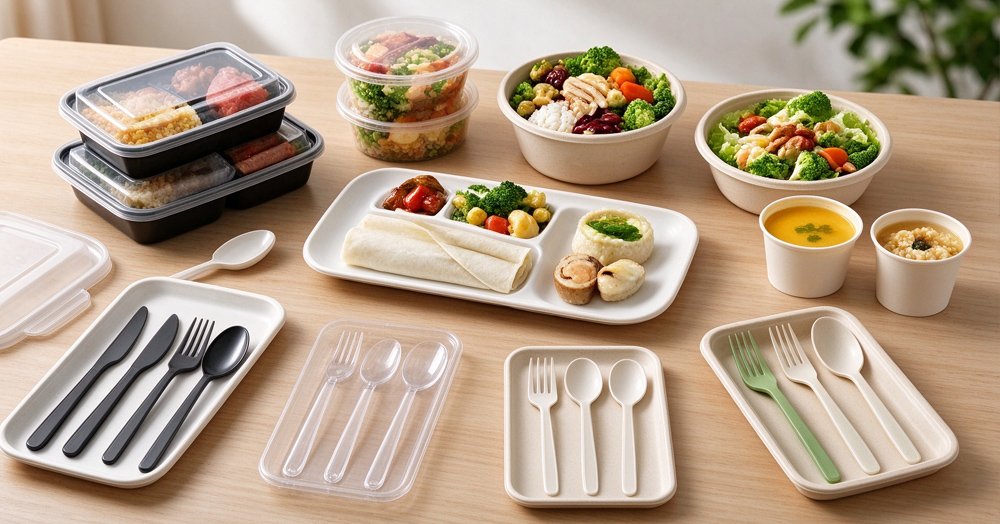
Understanding the material science utilized by leading biodegradable cutlery manufacturers helps US buyers avoid common selection pitfalls. Some early products used pulp or bagasse fibers, which easily softened, shed debris, or produced odors in hot soup or high-oil environments.
Modern polymer eco-friendly cutlery uses PET, PLA, PP, bio-based, and biodegradable composite materials (excluding paper and bagasse), improving durability and environmental compatibility from molecular structure and formulation design:
- PLA (Polylactic Acid): Polymerized through fermentation of renewable plant starches such as corn and cassava, featuring a smooth surface, non-toxicity, and odorlessness, decomposing into carbon dioxide and water under industrial composting conditions.
- Bio-Based and Biodegradable Composite Materials: Blending and modifying bio-based resins with functional additives improves material crystallinity and usage strength, resulting in more balanced performance in US takeout and catering scenarios.
- Food-Grade PP and High-Clarity PET: Both are mature polymer food-contact materials; PP offers good heat resistance and toughness, while PET possesses high transparency and good barrier properties, widely used in American cold drink and food containers.
- Degradation and Germination Science: Measuring eco-friendly materials involves looking not only at the decomposition process but also at post-decomposition ecological safety. In standard testing, the germination time of relevant materials is controlled within 7-45 days, demonstrating that the residual substrate after degradation is friendly to plant seed germination without causing soil ecological burdens.
By scientifically distinguishing polymer bio-based materials from paper pulp and bagasse materials, US buyers can make more reliable product matches for different cold and hot food scenarios.
💡 Frequently Asked Questions
Q: What does the germination time (7-45 days) of biodegradable cutlery scientifically represent?
A: Germination time is used to evaluate the impact of degraded materials on plant seed germination and growth, serving as an important indicator of ecological safety. A 7-45 day germination time indicates that after decomposing under corresponding conditions, the material leaves no harmful residues that inhibit plant germination.
US Composting Standards and Plastic Ban Rules
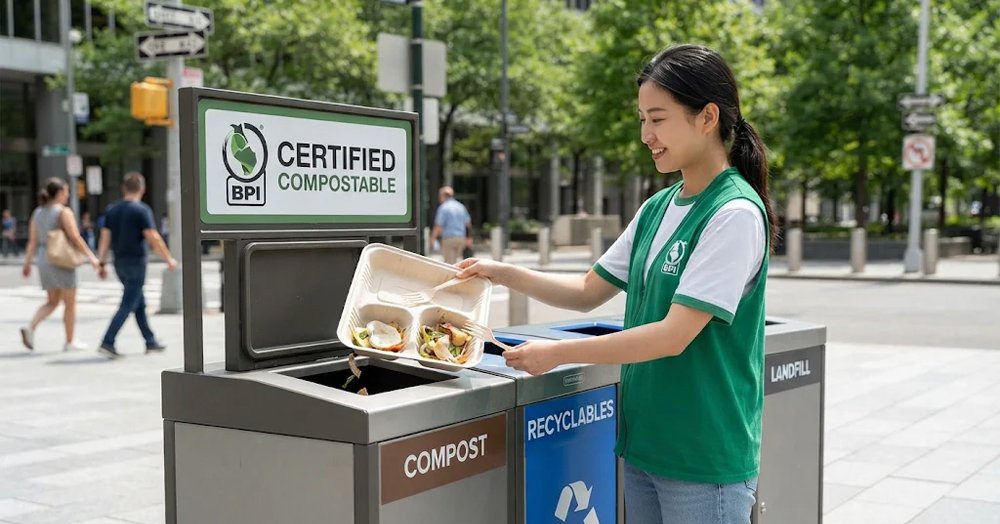
Navigating the American market requires wholesale disposable cutlery suppliers and buyers to understand how US federal guidance, state legislation, and commercial composting infrastructure govern product compliance. Across the United States, single-use plastic bans and labeling laws have reshaped what restaurants and distributors can legally sell.
American buyers and foodservice operators must align their product selection with four core US regulatory and composting mechanisms:
- ASTM D6400 and D6868 Standards: In the United States, industrial compostability is scientifically defined by ASTM D6400 (for solid plastic items like cutlery) and ASTM D6868 (for coated substrates), requiring rapid disintegration, biodegradation, and non-toxic soil outcomes.
- BPI Certification in North America: The Biodegradable Products Institute (BPI) verifies that products meet ASTM standards, serving as the primary benchmark required by US municipal composting facilities and major American foodservice distributors.
- US State-Level Single-Use Plastic Bans: States such as California (SB 54), Washington, New York, and Colorado enforce strict bans on conventional polystyrene and non-compostable single-use utensils, requiring verified compostable, recyclable, or reusable alternatives.
- Anti-Greenwashing Labeling Laws: Under US state laws like California’s AB 1201 and the FTC Green Guides, cutlery sold in America cannot use vague “biodegradable” claims unless supported by recognized scientific test data and clear composting instructions.
Understanding these US regulatory frameworks enables American distributors to stock compliant inventory, avoid municipal fines, and meet the procurement mandates of nationwide restaurant chains.
💡 Frequently Asked Questions
Q: What standards govern compostable disposable cutlery in the United States?
A: In the United States, compostable disposable cutlery is primarily governed by ASTM D6400 standards and verified through BPI certification, alongside strict state-level plastic reduction laws such as California’s SB 54 and AB 1201 labeling rules.
Cutlery Strength and Temperature Resistance Science
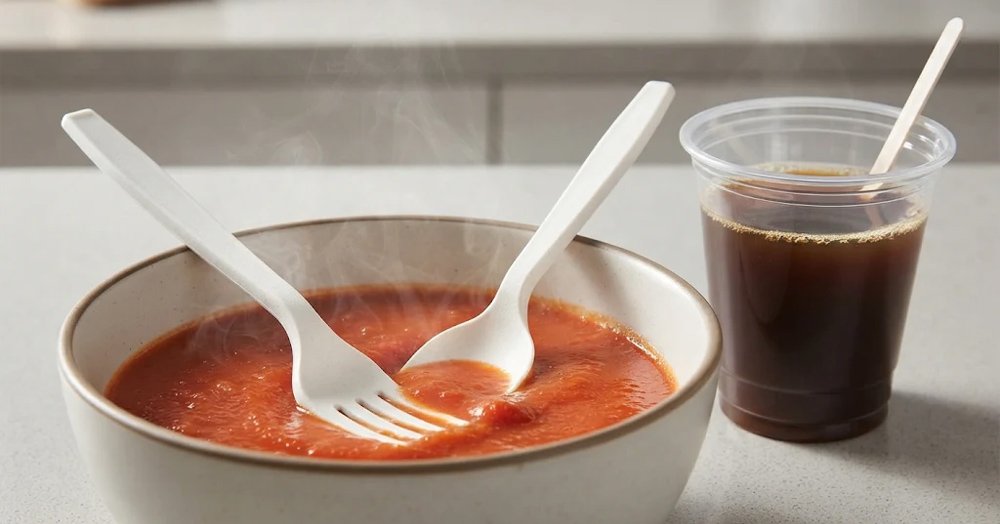
In daily US catering use, common consumer pain points include cutlery breaking when cutting hard foods or spoon handles softening in hot food environments. Analyzing the physical performance tested by biodegradable cutlery manufacturers centers on mechanical strength and thermal tolerance indicators.
When evaluating product practicality for American restaurants, buyers can focus on the following four physical performance factors:
- Flexural Modulus and Impact Resistance: Flexural modulus reflects resistance to bending deformation, while impact resistance reflects resistance to cracking under external impact; together they determine the reliability of cutlery when cutting and spearing food.
- Heat Deflection Temperature (HDT): The temperature threshold at which a material undergoes noticeable deformation under heat, directly affecting the shape retention of cutlery when contacting hot soup, hot dishes, or hot drinks.
- Structural Rib Design: Placing reinforcing ribs reasonably on handles or stress points improves overall bending rigidity while controlling weight, enhancing grip and user feel.
- Surface Density and Oil/Leak Resistance: The dense surface of PET, PLA, PP, and bio-based composite materials effectively blocks moisture and grease penetration, avoiding leakage or deformation caused by fiber water absorption and softening.
Mastering these mechanical and heat-resistance fundamentals helps US buyers select cutlery products that better fit end-user needs based on target dish temperatures and dining intensity.
💡 Frequently Asked Questions
Q: How can one judge from physical indicators whether disposable eco-friendly cutlery will easily soften in hot food scenarios?
A: Buyers can focus on checking the material’s Heat Deflection Temperature (HDT), modified crystallinity, and handle reinforcing rib structural design. Heat-resistant modified materials and reasonable structural design significantly enhance cutlery’s resistance to softening and deformation in hot food environments.
Guanzhong Factory Strength and Core Advantages
When US buyers screen wholesale disposable cutlery suppliers, a factory’s comprehensive scale, R&D strength, supply chain resilience, and delivery efficiency are key to long-term cooperation. Guanzhong demonstrates distinct advantages in the industry through its solid hardware foundation and full-cycle service capabilities.
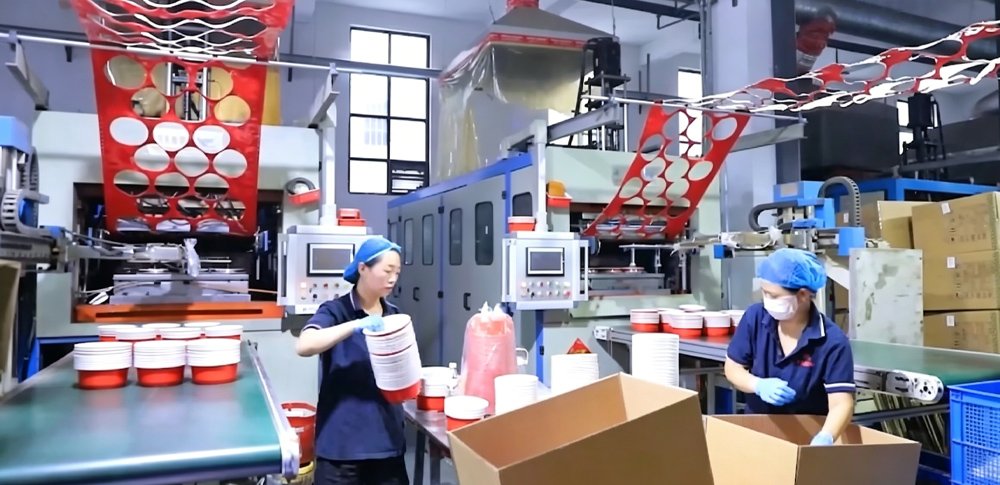
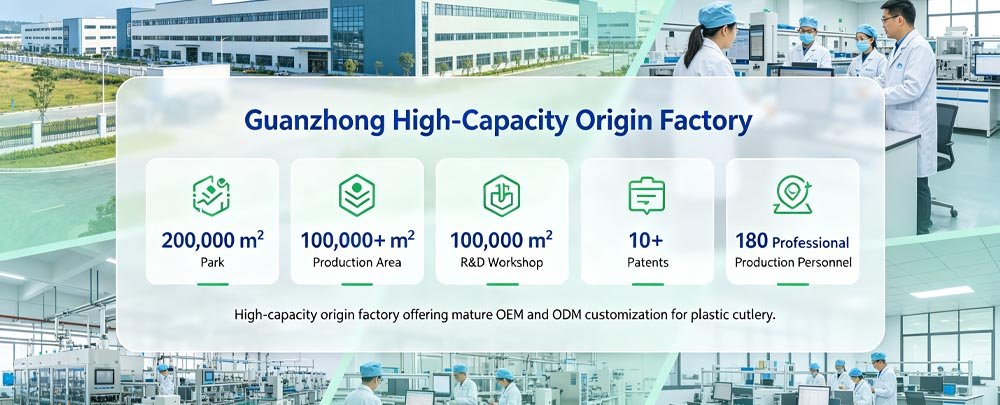
- Ultra-Large Industrial Park and Standard Plants: Guanzhong owns a nearly 200,000-square-meter industrial park, with production facilities exceeding 100,000 square meters, equipped with a 100,000-square-meter advanced R&D center and standardized workshops supporting large-scale continuous manufacturing.
- 90,000-Ton Annual Output and Professional Team: The factory has 180 production staff and a strong capacity of 90,000 tons in annual output, smoothly handling bulk wholesale orders and providing reliable volume guarantees for US and global buyers.
- 10+ Patents and Independent R&D: Relying on its advanced R&D center and 10+ patents, Guanzhong continuously optimizes material formulations and process stability to enhance overall product competitiveness.
- Pure Material System and Agile Delivery: Guanzhong uses high-quality PET, PLA, PP, bio-based, and biodegradable composite materials (excluding paper and bagasse), with a product germination time of 7-45 days, a production cycle of only 7-15 days, and support for flexible cooperation with a 30,000-piece minimum order quantity standard.
With its 200,000-square-meter industrial park, 90,000-ton annual output, 10+ patents, and 7-15 day production cycle, Guanzhong helps US wholesalers efficiently expand into the eco-friendly catering supplies market with high cost-effectiveness and fast responsiveness.
💡 Frequently Asked Questions
Q: What core advantages does Guanzhong have in handling bulk wholesale orders for disposable cutlery?
A: Guanzhong owns a nearly 200,000-square-meter industrial park, 100,000+ square meters of production facilities, 10+ patents, and 90,000-ton annual output, utilizing PET, PLA, PP, and bio-based composite materials (excluding paper and bagasse) with a 7-45 day germination time and a 7-15 day production cycle, combining high capacity, fast delivery, and high cost-effectiveness.
Contact Guanzhong today to get free PET, PLA, PP, and bio-based cutlery samples, product catalogs, and bulk wholesale quotation plans for the US market!
| Start Your Customization | WhatsApp: +86 13665956245 | Email: peters@quanzhong-bio.com |
Comparing the six representative biodegradable cutlery manufacturers and wholesale disposable cutlery suppliers in the US market shows that while local American factories suit short-distance replenishment, source factories with large-scale capacity and R&D strength better support long-term bulk profitability. Backed by its 200,000-square-meter industrial park, 90,000-ton annual output, 10+ patents, and 7-15 day efficient delivery system, Guanzhong centers on high-quality PET, PLA, PP, and bio-based composite materials to continuously provide US and global buyers with a stable and reliable supply of eco-friendly cutlery.