Table of contents
Overview of the European Biodegradable Garbage Bag Industry: Market Structure and Trends
Europe has long been a global leader in eco-friendly packaging and sustainable development, especially in reducing single-use plastics and promoting circular economy policies. With the implementation of the EU Single-Use Plastics Directive and various national plastic restrictions, biodegradable garbage bags have become an important alternative to conventional plastic bags.
Market Structure
The European biodegradable garbage bag market mainly consists of three types of enterprises:
- Specialized bioplastic manufacturers: such as Novamont and Biotec, focusing on the development of PLA, PBAT, PHA, and other materials.
- End-product bag manufacturers: including Guanzhong, transforming biodegradable materials into household garbage bags, kitchen waste bags, and other products.
- Brands and retail channels: major supermarket chains, home brands, and B2B eco-suppliers, playing a key role in market adoption.
These enterprises form a complete supply chain ecosystem of “raw material → manufacturing → distribution → recycling,” ensuring products can fully degrade after use while minimizing carbon footprints.
Market Trends
- Regulation-driven growth: European countries require all packaging materials to be recyclable or biodegradable by 2030, leading to annual growth rates over 15% for biodegradable garbage bags.
- Material diversification: From PLA and PBAT to corn-starch-based materials, manufacturers are continuously developing new formulas to improve flexibility, leak resistance, and degradation speed.
- Consumer awareness: Surveys show over 70% of European consumers are willing to pay more for sustainable products, particularly in Northern and Western Europe.
Overall, the European biodegradable garbage bag industry is shifting from policy-driven to innovation-driven, with international collaboration and technology upgrades becoming core competitive factors.
Europe’s Top 5 Biodegradable Garbage Bag Manufacturers
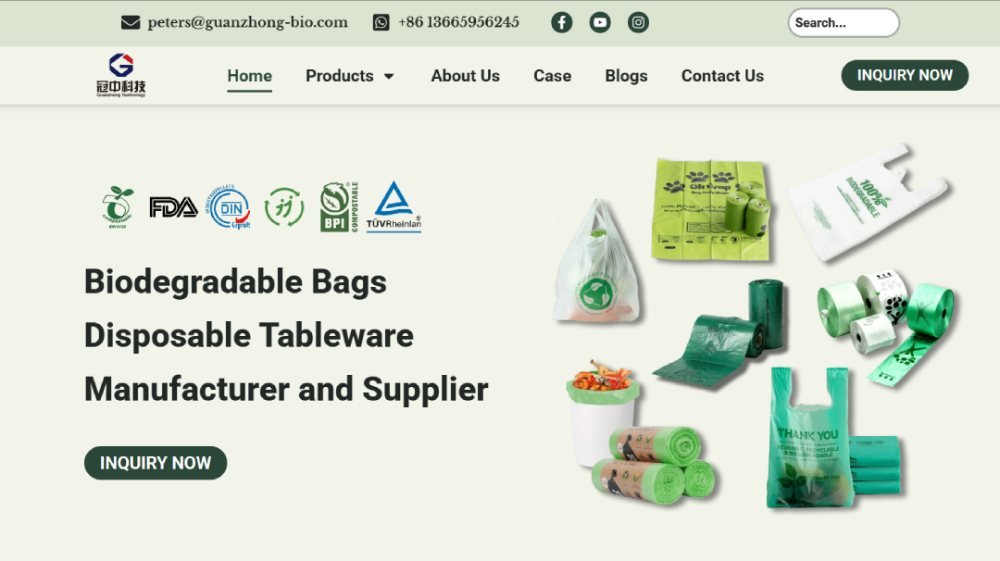
1. Guanzhong — A Trusted Partner in the European Market
As one of the professional biodegradable garbage bag manufacturers in China, Guanzhong has extensive experience in corn-starch-based biodegradable packaging.
Key Features:
- Leading eco-friendly materials: Uses renewable corn starch and PLA biobased resin; products fully degrade into water and CO₂ within 180 days in composting conditions.
- Advanced production system: Modern smart factory equipped with multiple automated film-blowing and bag-making lines, supporting annual production of hundreds of millions of biodegradable garbage bags with customizable sizes and thicknesses.
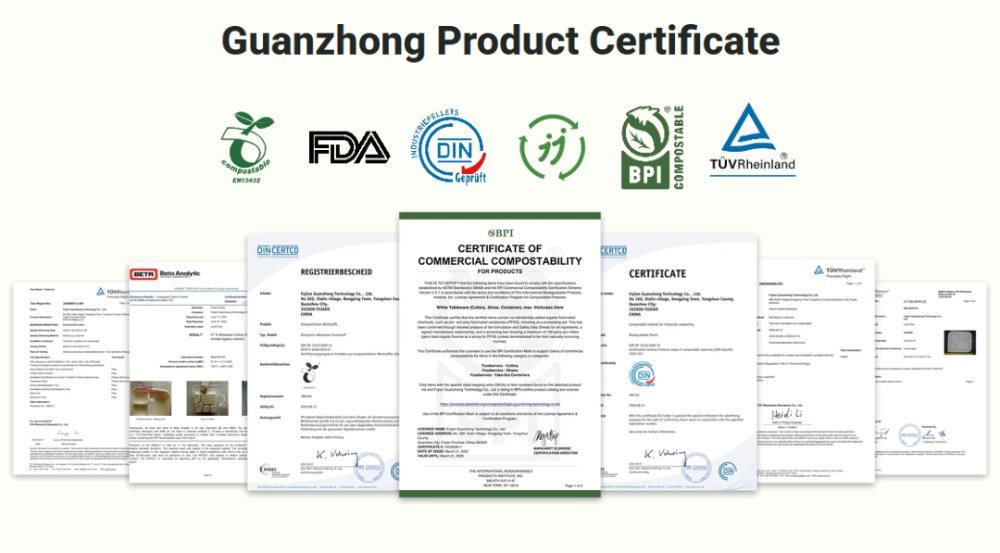
- Strict certification system: Products meet EN 13432, OK Compost, BPI, and other international standards.
- Deep collaboration with European brands: Provides OEM/ODM services for supermarkets and e-commerce platforms, ensuring stable export experience and supply chain responsiveness.
- Customizable solutions: Offers full-service options from material formula adjustment, logo printing, to packaging design, meeting brand requirements.
- Professional manufacturing expertise: Possesses reliable production techniques and quality control, ensuring consistent performance under diverse usage scenarios.
With high quality, eco-friendliness, and international compliance, Guanzhong is a trusted partner for many European companies.
2. Novamont (Italy) — Pioneer in Biodegradable Materials
- Material innovation: Developer of Mater-Bi® proprietary material, a composite of plant oils and biopolyesters.
- Industrial layout: Operates multiple biorefinery plants in Italy with full traceability from raw materials to finished products.
- Eco-friendly philosophy: Actively promotes “Earth-friendly plastics” policies and collaborates with EU research institutes to establish biodegradable standards.
3. Biotec (Germany) — Expert in High-Performance Compost Bags
- Product characteristics: Focuses on industrial and household compostable garbage bags made from high-strength PBAT and PLA blends.
- Technical highlights: Utilizes proprietary Bio-Flex® polymer technology for superior puncture resistance and sealing performance.
- Certification system: DIN CERTCO and OK Compost certified, widely recognized across Europe.
4. Sphere Group (France) — One of Europe’s Largest Household Bag Producers
- Group scale: Annual production exceeds 120,000 tons, covering garbage bags, freezer bags, and food preservation bags.
- Biodegradable lineup: BioSphere series focuses on plant-based and compostable bags, mainly distributed in France, the UK, and Spain.
- Brand strategy: Collaborates with major retailers to promote eco-friendly alternatives, dominating the French market.
5. Tipa (Israel/European Market) — Innovator in Degradable Flexible Packaging
- Innovation focus: Specializes in biodegradable solutions for flexible packaging and mailing bags, extending to garbage bags and e-commerce packaging.
- Technical advantage: Products fully decompose under home compost conditions without leaving microplastic residues.
- Market influence: Partners with European fashion and food brands such as Waitrose and Stella McCartney, demonstrating brand recognition.
How to Choose the Right Biodegradable Garbage Bag Manufacturer
When selecting a supplier, companies should consider several factors:
- Certification and standards compliance: Prioritize manufacturers with EN 13432, OK Compost, or BPI certifications to ensure legality in European markets.
- Raw material transparency: Reliable bio bag manufacturers disclose raw material composition and sources, ensuring no non-biodegradable plastics like PE or PP are included.
- Production capacity and delivery time: Choose suppliers capable of stable output and short lead times based on your procurement volume.
- Customization capabilities: High-quality suppliers provide size, thickness, color, and logo printing options to meet branding needs.
- After-sales and technical support: A comprehensive service system guarantees long-term cooperation, especially for cross-border orders.
- Sustainability and traceability: Assess whether the manufacturer can provide traceable supply chains and environmentally responsible production practices.
- Reputation and experience: Look for manufacturers with proven export experience, customer reviews, and established relationships with European brands.
- Innovation capacity: Evaluate whether the supplier continuously improves material performance, durability, and composting efficiency through R&D and process optimization.
Applications and Future Potential of Biodegradable Garbage Bags
Main Application Areas
With stricter European environmental regulations and increasing consumer awareness, biodegradable garbage bags are used across households, commercial sectors, industry, and public institutions. They play a crucial role in reducing plastic use:
- Households and community waste sorting: Used in kitchens, bathrooms, and community waste collection, especially for organic waste. Corn-starch-based compostable bags prevent leaks and odors and fully degrade in compost conditions. Community composting sites in Germany and France widely adopt such bags.
- Commercial and catering industries: Restaurants, takeaways, hotels, and supermarkets increasingly require eco-friendly packaging. Corn-starch-based biodegradable bags from biodegradable garbage bag manufacturers provide oil and liquid resistance, tensile strength, and durability for food waste handling.
- Industrial and agricultural use: Used for light industrial waste like packaging scraps, fabric residues, and in agriculture for garden or fruit/vegetable waste management, directly entering compost systems without sorting.
- Government and public institutions: Many European governments integrate biodegradable bags into public procurement for city sanitation, schools, hospitals, and government offices. Cities in Italy and Sweden have fully replaced conventional plastic bags.
- E-commerce and logistics: With rapid e-commerce growth, biodegradable mailing bags gradually replace conventional plastics. European online brands use these as part of their sustainable supply chain and eco-branding initiatives.
Future Market Potential and Trends
Over the next 5–10 years, the European biodegradable garbage bag market is expected to grow steadily. Statista projects that by 2030, Europe’s biodegradable plastic packaging market will exceed €12 billion, with garbage bags and household packaging accounting for about 35%.
Growth is driven by policy, technology, and consumer demand. EU regulations gradually phase out single-use non-degradable plastics, supporting market expansion. Advances in PLA and PBAT composite modification enhance bag durability and composting efficiency. Increasing consumer awareness pushes brands toward adopting biodegradable packaging, boosting market acceptance.
| Start Your Customization | WhatsApp: +86 13665956245 | Email: peters@quanzhong-bio.com |
From technological innovation to policy support, from material development to brand cooperation, Europe’s biodegradable garbage bag industry is experiencing rapid growth. Manufacturers with international vision and sustainable production capacity, like biodegradable garbage bag manufacturers, serve as bridges connecting Asian manufacturing with the European eco-market.
Choosing the right bio bag manufacturer is not only a procurement decision but also a strategic step toward a greener brand future. Every bag selected contributes to a healthier planet.