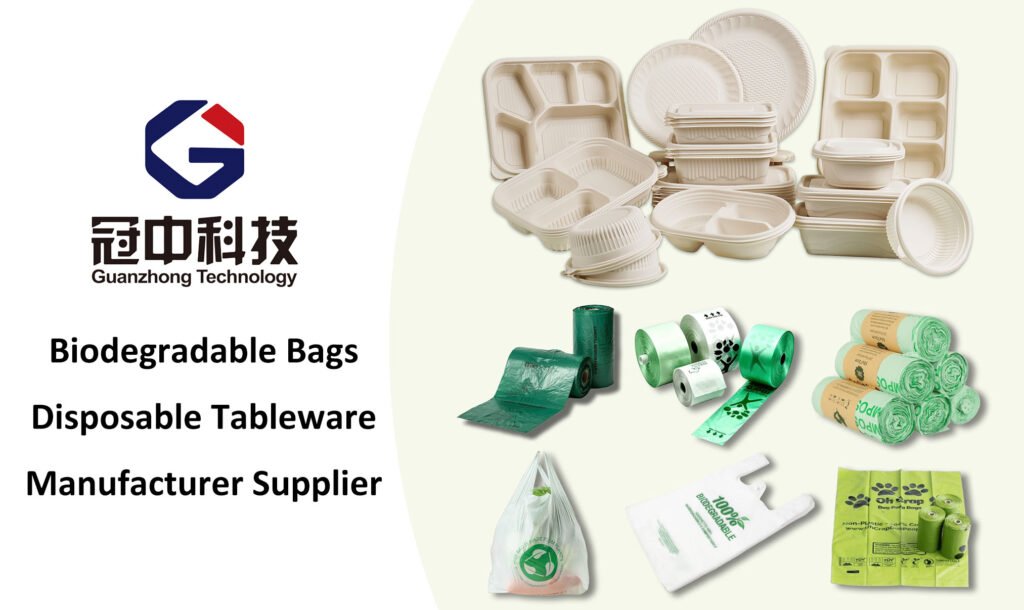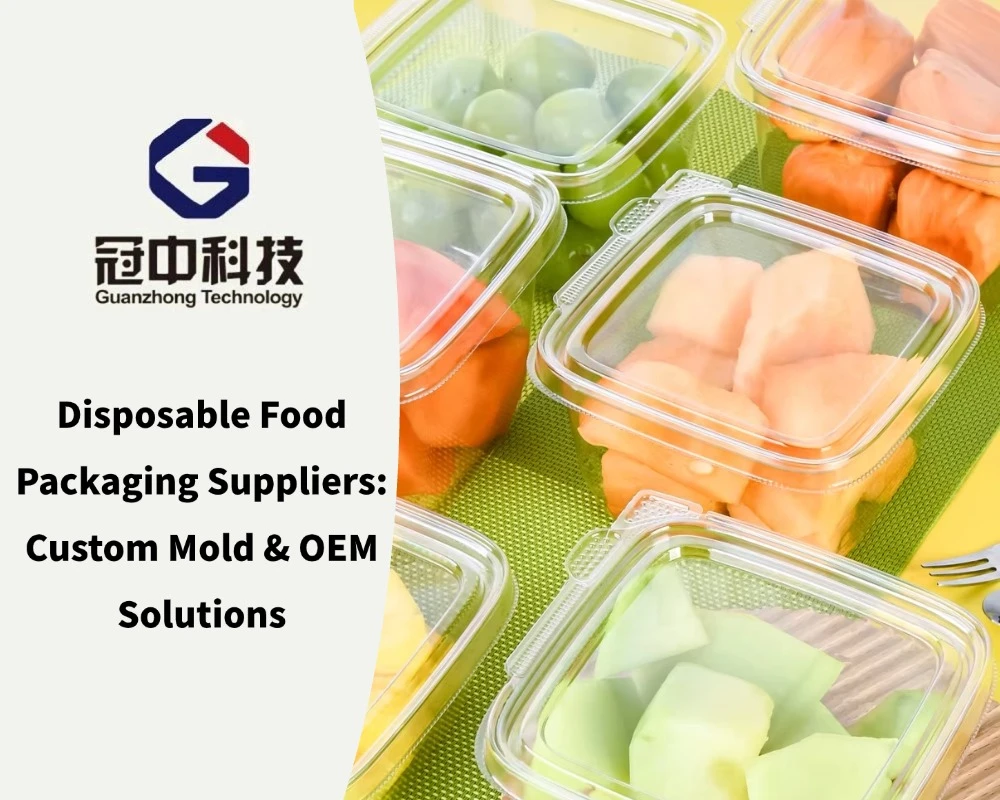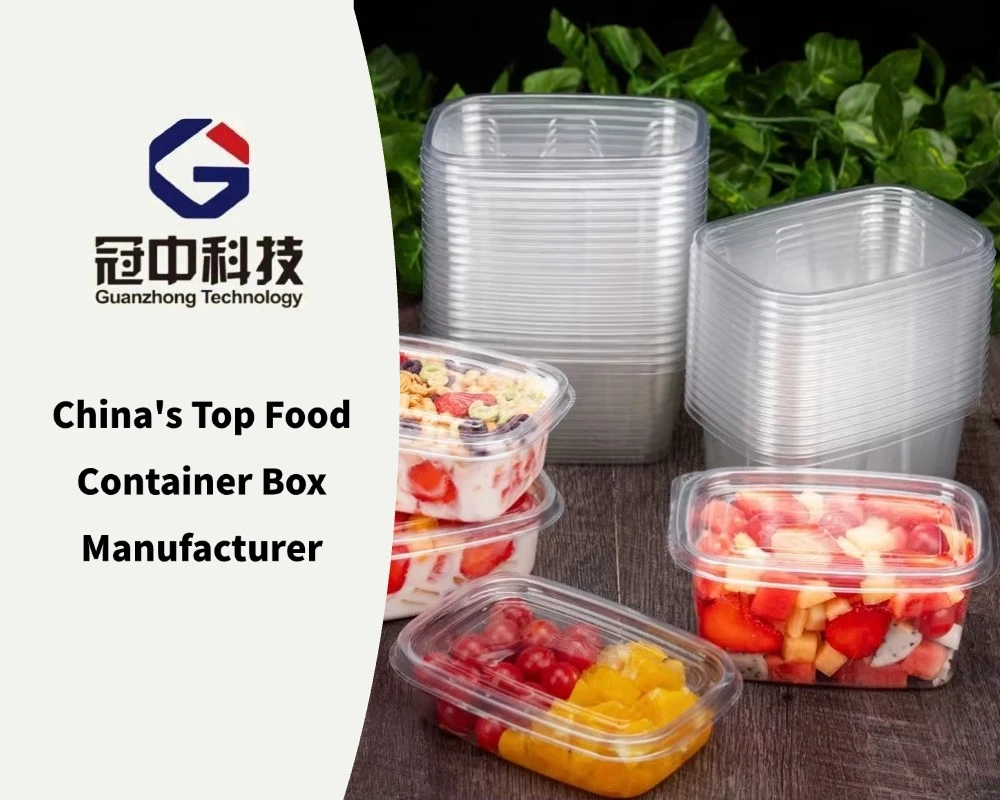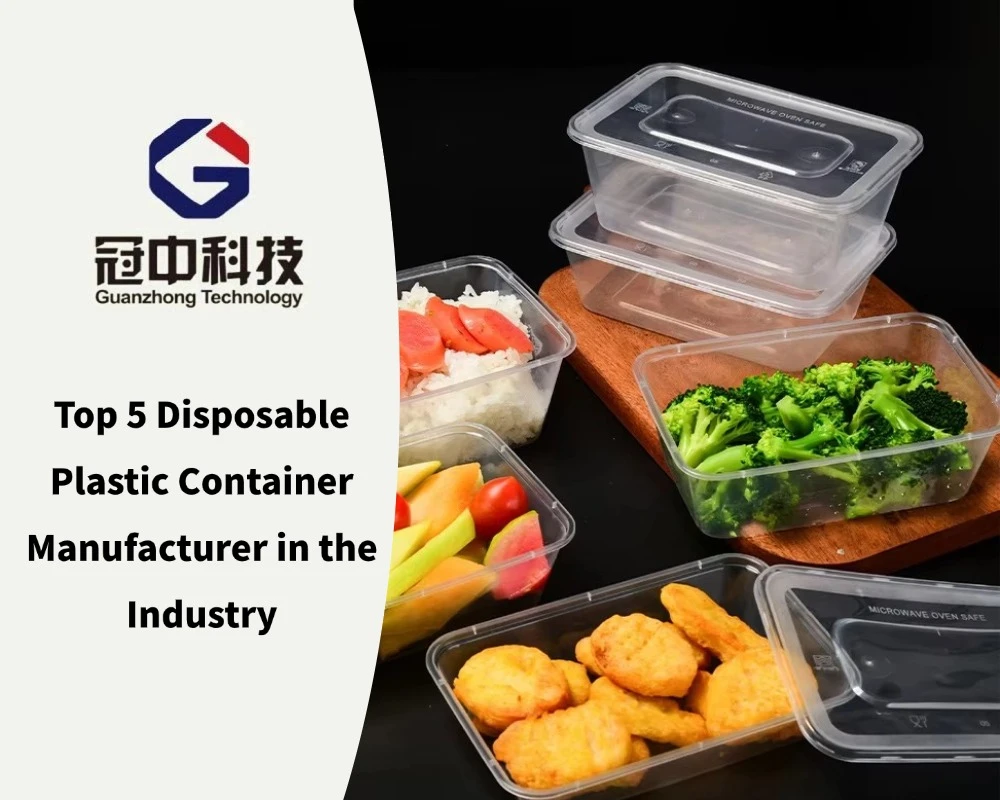
As a leading global disposable food containers suppliers company, guanzhong leverages its robust industrial manufacturing power and cutting-edge green degradation technology to provide global buyers with a one-stop deep customization solution for takeaway containers wholesale, serving as a solid backbone to boost the business growth of medium-to-large catering enterprises and multinational buyers.
Key Takeaways
- Source Factory Strength: guanzhong boasts a 200,000-square-meter industrial park, 100,000+ square meters of standardized workshops, and an annual output reaching 90,000 tons.
- Cutting-Edge Capacity: Equipped with 50 fully automated injection molding production lines (monthly capacity of 2,000 tons) and 8 fully automated thermoforming lines (monthly capacity of 800 tons), ensuring extremely stable supply.
- Green Eco-Friendly Materials: Specializing in PET, PLA, PP, as well as bio-based and biodegradable composite materials (excluding paper and sugarcane), with an eco-friendly material degradation and germination time of only 7–45 days.
- Flexible Customization: Supporting Logo printing, custom shapes, and dimensions, with a minimum order quantity (MOQ) of 30,000 pieces for custom tableware and plates, and a rapid production cycle of only 7–15 days.
Guanzhong 200,000㎡ Green Factory Strength
When evaluating the long-term cooperation value of disposable food containers suppliers, the physical scale and core capabilities of the factory serve as an unshakable cornerstone. This not only determines the ceiling for handling large-scale orders but also directly impacts the batch-to-batch consistency of product quality.
To give global buyers a stronger competitive edge in packaging procurement, guanzhong is committed to deeply integrating environmental philosophy with modern industrial manufacturing. Through continuous R&D investment, we have built exceptionally high industry barriers in raw material modification and structural design, ensuring that every container leaving our facility possesses outstanding physical properties.
The following table summarizes the core production indicators of guanzhong to help you intuitively evaluate our supply capability and partnership security:
| Core Evaluation Metric | guanzhong Official Data | Key Benefits for B2B Buyers |
| Total Industrial Park Area | 200,000 square meters | Strong physical enterprise background, ensuring worry-free long-term cooperation |
| Standardized Production Workshops | 100,000+ square meters | Clean, temperature-controlled, and high-standard modern food-grade production environment |
| Professional Production & Technical Staff | Over 180 personnel | Experienced industry team, ensuring seamless transition from mold development to quality control |
| Annual Designed Production Capacity | 90,000 tons | Meeting the seamless replenishment needs of mega chain restaurants and multinational wholesalers |
| Core R&D Credentials | 10+ independent R&D patents | Ensuring technical leadership in sealing performance, temperature resistance, and environmental degradation |
💡 Frequently Asked Questions
Q: Why choose guanzhong as your primary takeaway containers wholesale supplier?
A: Choosing guanzhong means you are partnering directly with a source factory that owns a 200,000-square-meter industrial park, 100,000+ square meters of standardized workshops, and an annual output of 90,000 tons. Compared to middleman trading companies, we possess 10+ R&D patents, allowing us to directly control food-grade production from the source, eliminate multi-tier markups, and offer the highest level of security for global bulk procurement in terms of production scale and industry certifications.
Guanzhong Automation Production Line Analysis
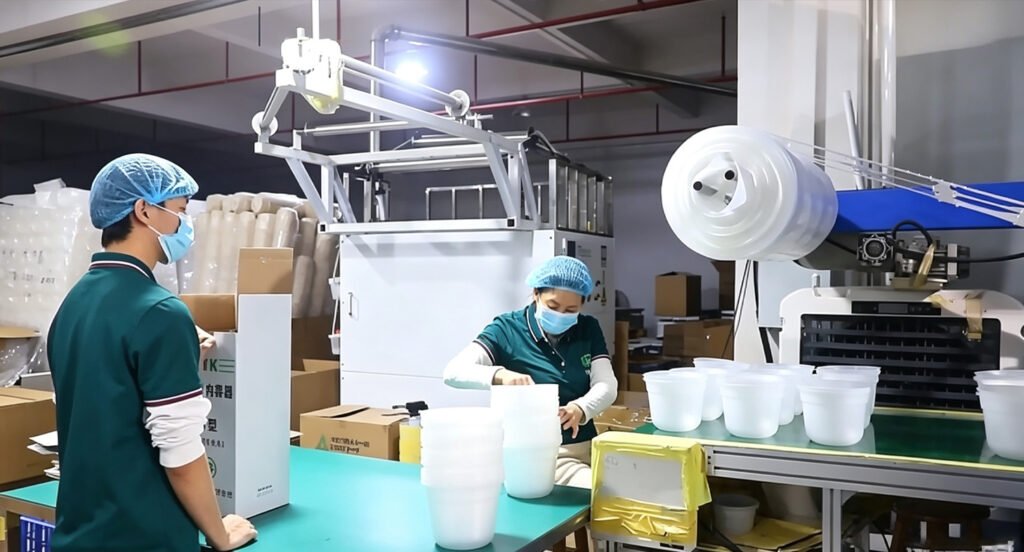
High standards of automated production are the underlying code for ensuring the consistency of high-quality food-grade packaging and ultra-short delivery windows. guanzhong firmly rejects outdated semi-automatic processing models, achieving a high degree of digital control and automation across the entire factory.
In our core food container production department, our automated workshops deploy an exceptionally robust machinery matrix:
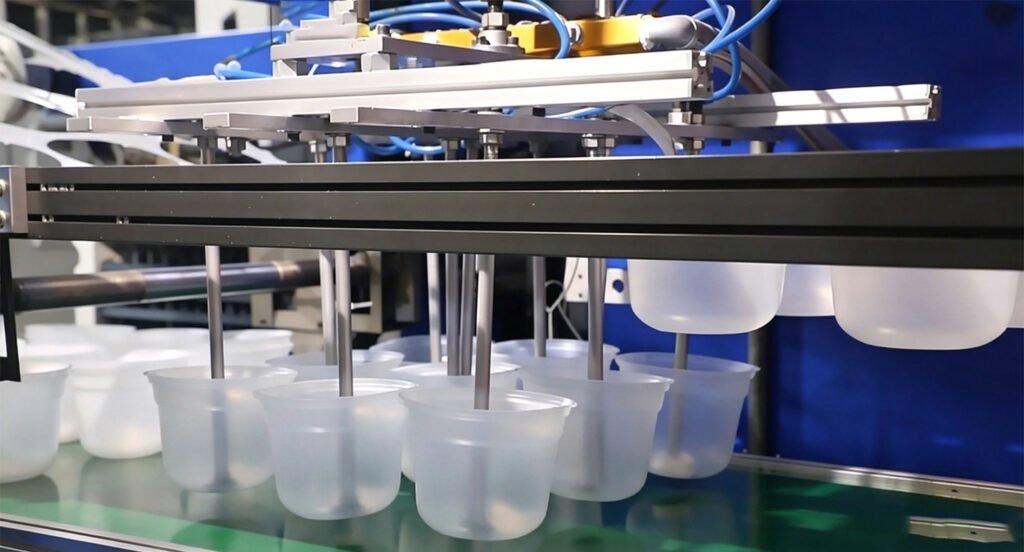
- Fully Automated Injection Molding Lines: We operate 50 fully automated injection molding production lines. This system enables automatic raw material proportioning, precise robotic demolding, and fully enclosed dust-free conveying, achieving a monthly capacity of approximately 2,000 tons. This line is primary utilized for manufacturing high-strength, high-transparency, microwave-safe, and excellently sealed food containers.
- Fully Automated Thermoforming Lines: To address high-efficiency thermoforming packaging needs for large-volume and diverse specifications, we have introduced 8 fully automated high-speed thermoforming lines, reaching a monthly capacity of approximately 800 tons. Precision mold controls ensure that every thermoformed container and lid lock together perfectly, remaining leak-proof.
- Bio-based & Biodegradable Sheet Extrusion Lines: We are equipped with 3 biodegradable sheet extrusion production lines and 5 bio-based modified masterbatch production lines, with a monthly capacity of approximately 2,000 tons. This allows us to complete independent R&D and modification from raw eco-friendly masterbatch to degraded sheets directly within our facility, fundamentally securing raw material stability and physical performance tuning for our eco-friendly containers.
This integrated chain of “upstream modified material preparation + downstream precise molding” not only grants guanzhong exceptional risk resistance against raw material price fluctuations but also guarantees unmatched delivery certainty for every buyer seeking takeaway containers wholesale.
💡 Frequently Asked Questions
Q: What is guanzhong’s monthly production capacity for food containers?
A: Supported by a fully automated manufacturing system, guanzhong boasts incredible monthly supply flexibility. Our 50 fully automated injection molding lines yield a monthly capacity of 2,000 tons, and our 8 thermoforming lines produce 800 tons per month. Furthermore, our independent monthly capacity for upstream bio-based modified materials reaches 2,000 tons, fully capable of managing sudden surges in large-scale orders from global buyers and ensuring a highly reliable supply chain.
Premium Lunch Boxes: Material and Environmental Friendliness
Against the backdrop of the global low-carbon economy, end consumers and international environmental regulators are increasingly stringent in auditing food packaging materials. guanzhong actively delivers on its green development commitments, establishing three major standards in product R&D: purity, high physical performance, and complete biodegradability.
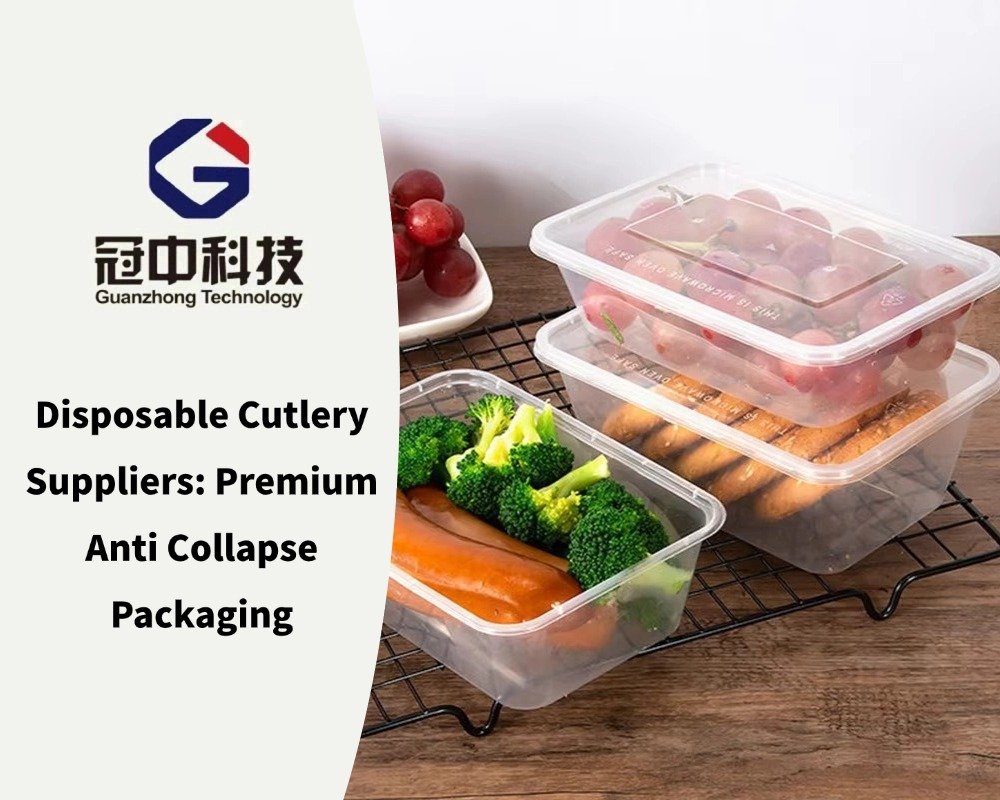
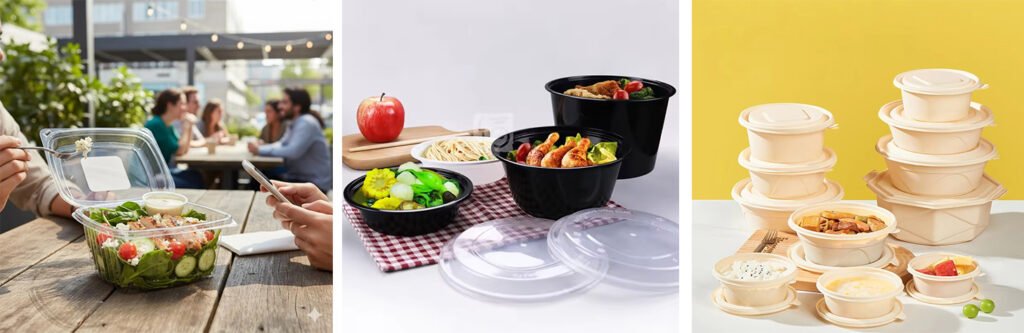
We firmly exclude paper and sugarcane—traditional fiber materials that are prone to softening, lack heat resistance, and easily leak. Instead, we focus on the advanced development of polymer materials and new bio-based materials, offering primary the following food-grade material containers:
- Food-Grade PP (Polypropylene):Features outstanding heat resistance (-20°C to 120°C), supporting microwave heating and freezer storage, making it the premier choice for oily, hot soup takeaway scenarios.
- High-Transparency PET (Polyester):Boasts unparalleled glass-like clarity and superior barrier properties, commonly used in high-end cold food, salad, and sushi packaging.
- PLA (Polylactic Acid) & Biodegradable Materials:100% derived from renewable plant resources like corn and cassava. Under composting conditions, our biodegradable composite materials achieve a degradation and germination time of just 7–45 days, ultimately converting fully into carbon dioxide and water without generating any microplastic pollution. This easily meets multiple strict global food contact and biodegradability standards.
By upgrading our polymer formulas, our biodegradable materials not only perform superbly in environmental attributes but also reach industrial levels comparable to traditional plastics in tensile strength, impact resistance, and sealing elasticity. This completely resolves the common market pain points of biodegradable containers being “brittle, prone to leakage, and poor to the touch,” redefining premium green containers with real performance.
💡 Frequently Asked Questions
Q: Are guanzhong’s biodegradable food containers fully compostable, and how long does it take to degrade?
A: Yes. The eco-friendly disposable containers produced by guanzhong utilize self-modified PLA, bio-based, and biodegradable composite materials (fully excluding paper and sugarcane). In industrial composting or specific soil environments, their degradation and germination time is only 7–45 days. The products contain no toxic heavy metals and leave no microplastic residues, making them the ideal choice for global restaurant groups sourcing eco-friendly packaging.
Guanzhong Flexible Customization and Ultra-Fast Delivery
For mid-to-large B2B buyers, standard products are merely the baseline. How to implement “flexible customization” for specific food service scenarios and achieve “ultra-fast delivery” in a rapidly changing market is the true test of a company’s status as a premium disposable food containers suppliers partner.
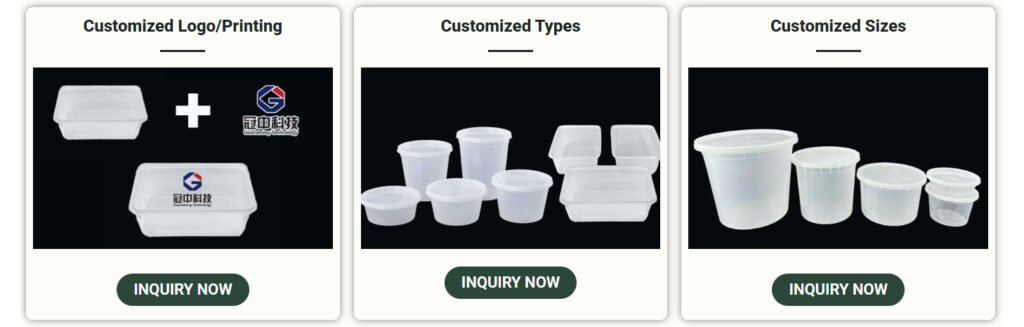
guanzhong provides deep, one-stop OEM/ODM solutions. Drawing upon our extensive technical accumulation in injection molding and thermoforming, we can develop custom molds and confirm samples in an incredibly short timeframe based on 3D drawings or physical samples provided by clients.
To make your brand stand out in the end market, we offer multi-dimensional customization support:
- Custom Types & Dimensions: Supporting single-compartment, dual-compartment, and multi-compartment divided designs, paired with high-performance leak-proof lids, along with custom heights and capacities.
- Custom Logo & Visual Printing: Supporting high-precision corporate Logo embossing/debossing on the container body and lid, or high-definition color printing using food-grade eco-friendly inks.
- Friendly & Reasonable Customization Threshold: To reduce upfront development costs for buyers, we maintain a highly accessible minimum order quantity (MOQ) starting at 30,000 pieces for custom tableware and plates.
- 7–15 Days Rapid Production Cycle: Thanks to our 180 experienced production personnel and twenty-four-hour automated assembly lines, we can finish production and arrange shipment in as fast as 7–15 days after sample and design approval, delivering at speeds far exceeding the industry average.
💡 Frequently Asked Questions
Q: What custom options and minimum order quantities (MOQ) does guanzhong offer?
A: guanzhong offers comprehensive OEM/ODM customization, including custom Logo printing, embossing, proprietary shape development, and specific sizing. To help clients stand out from the competition, our minimum order quantity (MOQ) for custom tableware and plates is only 30,000 pieces, with a production cycle compressed to 7–15 days, enabling low MOQs with rapid turnaround.
Guanzhong Wholesale Cooperation Core Advantages
As the supply chain backbone for global food packaging retailers, wholesalers, and chain brands, guanzhong provides unassailable competitive barriers for bulk cooperation partners by creating a highly integrated industrial closed loop:
- Closed-Loop Industrial Chain for Lower Costs: We independently operate 3 sheet extrusion lines and 5 masterbatch modification lines, achieving a complete closed loop from “modified raw material R&D to sheet self-production, and final food container molding.” Compared to traditional factories that must purchase sheets externally, we eliminate multi-tier raw material markup, directly translating these supply chain savings into highly competitive factory wholesale prices.
- Strict International Standards for Seamless Customs Clearance: We utilize online automatic vision inspection systems to automatically reject minor defects and deformations. All PP, PET, PLA, and bio-based composite containers comply with international food contact safety standards. Our complete technical documentation and certifications assist your shipments in clearing customs smoothly worldwide.
- Price-Locking Mechanism & Efficient Shipping to Mitigate Supply Chain Risk: For long-term wholesale partners, we offer flexible raw material price-locking policies to effectively hedge against fluctuations in international commodity prices. Additionally, we provide optimized container loading plans and container space reservations to keep our clients’ overseas warehouse inventory safe and stable over the long term.
💡 Frequently Asked Questions
Q: How does guanzhong support bulk buyers with wholesale pricing and shipping?
A: guanzhong features an integrated closed-loop manufacturing system, mass-producing its own modified masterbatch and sheets to eliminate external purchasing markups, thereby offering bulk wholesalers highly competitive factory-direct prices without middlemen. For long-term contract clients, we provide special price-lock mechanisms alongside flexible container consolidation and ocean shipping logistics coordination to ensure worry-free global sourcing with controlled costs.
| Start Your Customization | WhatsApp: +86 13665956245 | Email: peters@quanzhong-bio.com |
In today’s world, where global plastic restriction policies are forcing the upgrade of food packaging, having a source factory that is powerful in capacity, professional in materials, and compliant in environmental standards is your strongest core competitiveness.
Leveraging its 200,000-square-meter industrial park, 90,000-ton annual production capacity, advanced automated equipment, and leading biodegradable technology, guanzhong is committed to providing global B2B buyers with highly cost-effective, rapid-turnaround takeaway containers wholesale customization and wholesale services. We are not just container manufacturers; we are co-builders of your green supply chain.
Are you looking for a high-quality, compliant source supplier of eco-friendly disposable food containers? Looking to develop custom OEM molds for the best-selling container shapes in your local market?
Contact our expert team today! We will provide you with a one-on-one technical feasibility assessment, a detailed tiered wholesale quotation, and send free samples for physical testing to help your green catering business take off at full speed!