Key Takeaways
- Mold development and OEM customization are the core of reducing bulk purchasing unit prices; precise multi-cavity injection molds can effectively control tableware draft angles and flash tolerances.
- Through stiffener ribs and handle structural mechanics optimization, material weight can be reduced by 15%-20% without sacrificing fork and knife rigidity, significantly lowering logistics and production costs.
- PET, PP, PLA, and bio-based modified materials each have their applicable scenarios: PP has strong heat resistance, PET offers high transparency, and PLA together with bio-based materials can perfectly comply with strict global plastic ban environmental regulations.
- Evaluating a factory requires focusing on scale capacity and delivery cycles: factories with production cycles controlled within 7-15 days and MOQs as low as 30,000 pieces possess higher supply chain flexibility.
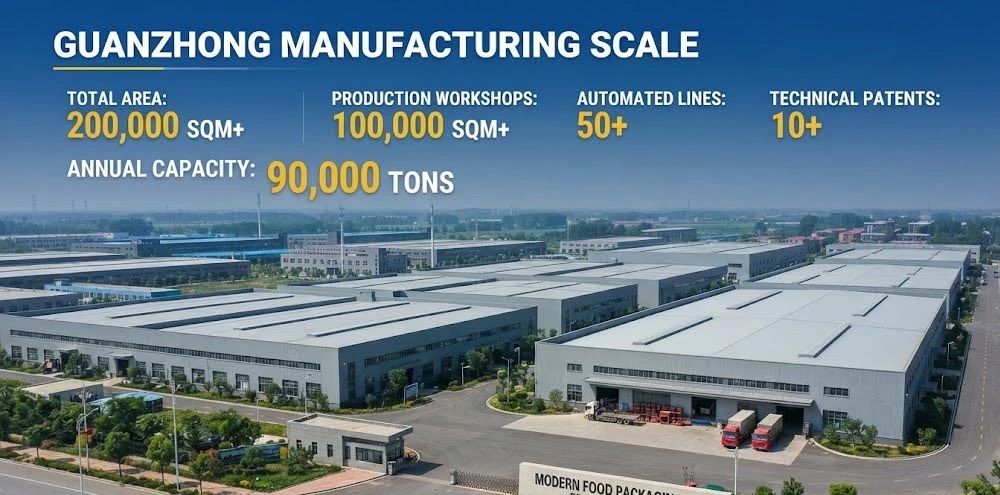
- As a powerful source factory, Guanzhong boasts a 200,000-square-meter industrial park, 50 fully automated injection moulding lines, and an annual output of up to 90,000 tons, fully empowering global buyers.
Driven by the accelerated progress of global “plastic bans” and the rapid expansion of the catering takeaway market, catering chain brands, takeaway packaging distributors, and B2B buyers seeking bento box disposable wholesale solutions are facing unprecedented supply chain upgrade pressure. From the precision development of custom molds, to OEM structural optimization balancing lightweighting and rigidity, to the accurate material selection of PET, PP, PLA, and bio-based modified materials, every production detail directly relates to corporate procurement costs, brand image, and compliance risks.
As one of the premier disposable food packaging suppliers in the industry, Guanzhong, combining its scale strength of a 200,000-square-meter industrial park and a 90,000-ton annual output with authoritative international compliance certifications, presents you with an exclusive high-quality purchasing guide for custom disposable cutlery and food containers.
Disposable Cutlery Mold Development Full Process Analysis
In B2B tableware procurement, mold development is the core phase of OEM customization for disposable cutlery and takeaway boxes. Precise injection mold design not only directly determines product appearance details, but also fundamentally affects production scrap rates and single-piece weight control.
- Precise Draft Angle Design: Ensures cutlery demolds smoothly after high-speed injection molding, completely avoiding edge flash and localized drag marks.
- Multi-Cavity Balanced Runner System: Achieves uniform filling of molten plastic across each mold cavity, ensuring single-piece product wall thickness consistency during mass production.
- High-Quality Cooling Water Line Layout: Significantly shortens injection molding cycle time, boosting single-line daily output and reducing scrap rates from the source.
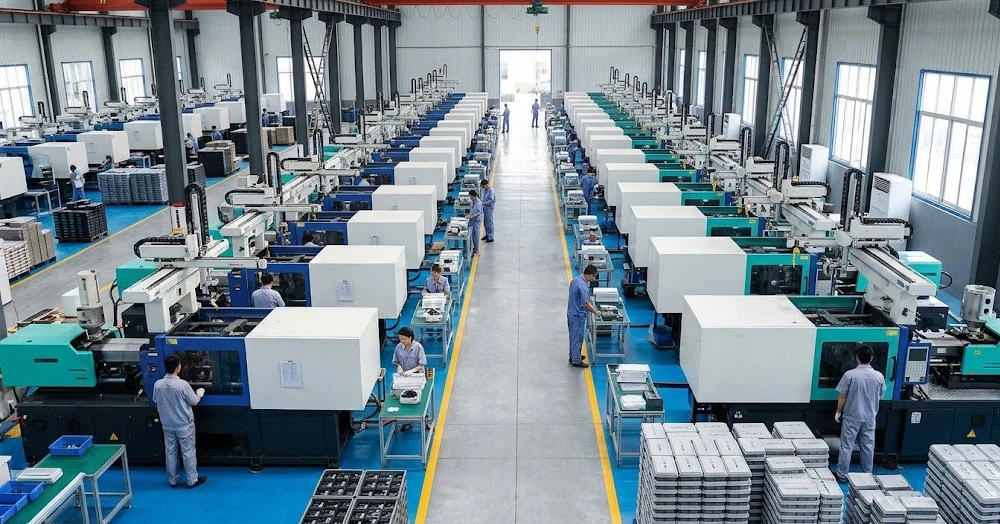
As an industry-leading disposable food packaging suppliers, Guanzhong possesses 100,000 square meters of standardized workshops and an advanced R&D center. The factory is equipped with 50 fully automated injection moulding production lines, with a monthly capacity of up to 2,000 tons. From drawing evaluation to trial mold sampling, the sprouting/sample cycle takes only 7-45 days, helping buyers quickly occupy the market.
When confirming mold plans, buyers should request full 3D flow analysis reports and weight tolerance ranges from the factory. Choosing a source factory with fully automated injection molding capabilities can ensure extremely high quality stability during mass production.
💡 Frequently Asked Questions
Q: How long does custom mold development for disposable cutlery usually take? How can costs be reduced?
A: Standard cutlery mold development typically takes 15-30 days. To reduce mold costs, buyers can choose multi-cavity shared mold base solutions or rapidly verify structures via 3D printing in early stages, while partnering with large-scale factories like Guanzhong that possess 10+ technical patents and independent R&D centers to utilize existing standardized mold base resources and reduce initial investment.
Weight & Structural Optimization in OEM Design
Structural design is key to balancing lightweighting and physical strength in disposable tableware. Traditional cutlery design often relies on increasing wall thickness to enhance rigidity, but this leads to excessive raw material consumption, increasing purchasing and transportation costs.
- Mechanical Stiffener Rib Layout: Strategically places reinforcement ribs at fork tooth junctions and knife handle backs to enhance bending strength without increasing thickness.
- Micro-Curved Handle Ergonomic Design: Utilizes cross-sectional mechanical structures to disperse stress, preventing breakage due to uneven force application during use.
- Streamlined Draft Weight Control: Finely reduces redundant wall thickness in non-load-bearing areas to achieve a substantial reduction in overall weight.
| Metric | Traditional Thick-Wall Design | Optimized Structural Design |
| Material Weight (g/pcs) | 5.5 – 6.0 | 4.2 – 4.8 |
| Flexural Strength | Baseline Strength | 12% Increase |
| Finished Product Yield Per Ton | ~170,000 pcs | ~220,000 pcs |
| Logistics Transport Cost | Baseline Cost | 15% Reduction |
In the bento box disposable wholesale business, Guanzhong provides buyers with comprehensive OEM/ODM deep customization services. The factory supports logo printing, custom shapes, and size customization, with a minimum order quantity (MOQ) for custom tableware and plates of only 30,000 pieces and a regular production cycle of just 7-15 days.
When carrying out product design, buyers need to determine physical performance metrics based on specific catering scenarios (such as heavy-oil Western food, light salads, or hot soups) to avoid unnecessary costs from over-engineering or poor end-user experience caused by insufficient strength.
💡 Frequently Asked Questions
Q: How can procurement costs be lowered via OEM structural design while maintaining cutlery hardness?
A: The key lies in “replacing weight with structure”. By adding reinforcement rib structures at fork tooth junctions and knife handle backs combined with high-flowability resin materials, plastic usage can be reduced by over 15% while maintaining original bending strength, thereby significantly lowering bulk procurement costs.
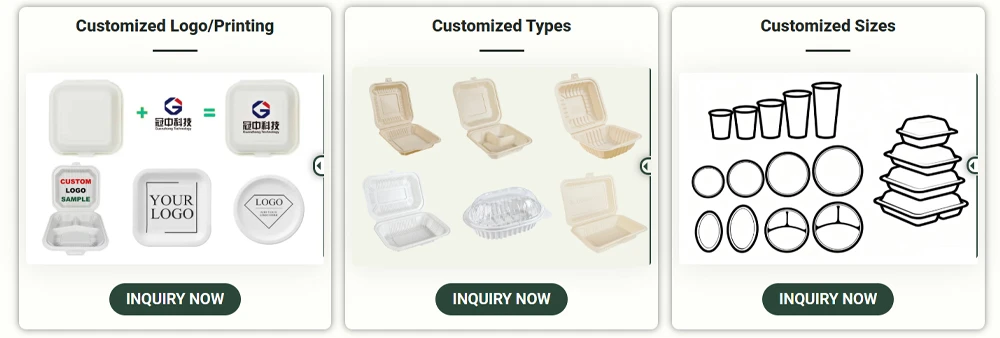
Comparison of PET PLA PP & Bio-Based Materials
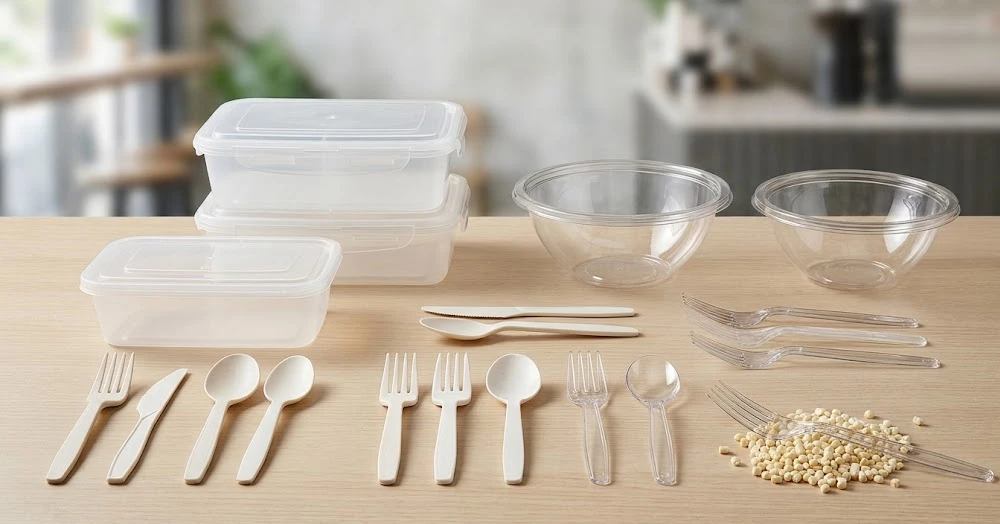
Selecting the right material is a critical step in custom disposable cutlery and food container production. Different materials exhibit significant variations in heat resistance, transparency, flexibility, and environmental compliance, requiring buyers to select accurately based on usage scenarios.
- PP (Polypropylene): Possesses excellent heat resistance (100°C-120°C) and microwave suitability, making it the top choice for hot food bento boxes and soup spoons.
- PET (Polyethylene Terephthalate): Offers extremely high transparency and rigidity, suitable for cold drinks, salad boxes, and transparent disposable cutlery packaging.
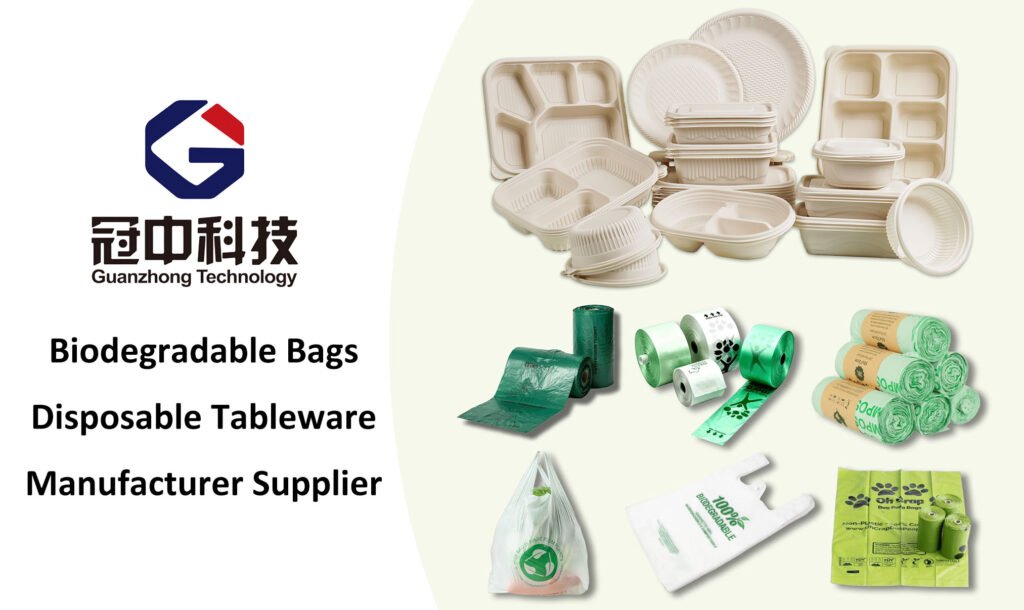
- PLA & Bio-Based Modified Materials: Feature excellent eco-friendly characteristics and degradability, perfectly complying with strict global plastic ban regulations.
| Material Type | Temperature Range (°C) | Transparency/Appearance | Environmental/Degradation Characteristics | Recommended Application |
| PP (Polypropylene) | -20°C to 120°C | Semi-transparent/Colorable | Recyclable | Microwave Bento Box |
| PET | -40°C to 70°C | High Transparency/Crystal Texture | Recyclable | Cold Drink/Salad Box |
| PLA (Polylactic Acid) | -10°C to 50°C | High Transparency | Industrially Compostable | Cold Meal Cutlery |
| Bio-Based Modified Materials | -20°C to 100°C | Semi-transparent/Milky White | Biodegradable/Carbon-Reducing | Hot Food/General Use |
As a powerful industrial manufacturing enterprise, Guanzhong owns an industrial park spanning 200,000 square meters, focusing on the R&D and production of premium PET, PLA, PP, bio-based, and biodegradable composite materials (production excludes paper and sugarcane). The factory is equipped with 3 biodegradable sheet extrusion lines and 5 bio-based modified masterbatch production lines, with a monthly modified material capacity of 2,000 tons.
When selecting suppliers, buyers should ensure the factory possesses independent modified masterbatch production capabilities. This not only guarantees consistent material physical performance, but also provides more competitive pricing when facing large-volume orders.
💡 Frequently Asked Questions
Q: Which material is best for disposable food containers and cutlery: PET, PP, or PLA?
A: This depends entirely on the application scenario. For heatable takeaway bento boxes, high-temperature resistant PP is recommended; for cold drinks, cut fruit, and high-transparency containers, PET is advised; if exporting to regions with strict plastic restrictions such as Europe and North America, PLA or bio-based biodegradable composite materials should be chosen.
Source Factory Quality Control & Capacity Assurance
When purchasing disposable tableware in bulk, buyers care most about the factory’s actual production scale, batch quality stability, and on-time delivery rate. A source factory with high automation levels and complete systems forms the foundation of supply chain security.
- Fully Automated Central Feeding System: Raw material ratio accuracy reaches micron level, ensuring melt flow index (MFI) consistency across every batch of products.
- Robotic Arm Automated Extraction & Packaging: Reduces direct manual contact, satisfying food-grade hygiene and safety requirements while improving production capacity.
- Online Real-Time Weight & Tension Monitoring: Online sampling inspections check product bending strength and wall thickness tolerances, preventing mass quality defects.
As a prominent disposable food packaging suppliers, Guanzhong has built a modern industrial park with 180 professional production personnel and an annual output reaching 90,000 tons. Beyond injection production lines, the factory also owns 8 fully automated thermoforming lines (monthly capacity 800 tons), 50 biodegradable film blowing lines and 25 bag making production lines (monthly capacity 1,500 tons), as well as 5 fully automated straw extrusion lines (monthly capacity 250 tons).
When performing factory audits, buyers should focus on inspecting the number of automated production lines, monthly capacity reserves, and quality control workflows from sample to mass production, ensuring the factory can complete tasks with guaranteed quality and quantity within a fast delivery cycle of 7-15 days.
💡 Frequently Asked Questions
Q: How to evaluate a factory’s actual capacity and delivery quality during bulk procurement of disposable tableware?
A: Evaluating a factory requires focusing on three hard metrics: First, look at automated equipment count and standardized plant area (such as owning over 100,000 square meters of workshop space and dozens of automated lines); second, look at monthly capacity and annual total output (such as monthly capacity above 2,000 tons); third, look at delivery cycle and MOQ flexibility (such as 7-15 days fast delivery and MOQs as low as 30,000 pieces).
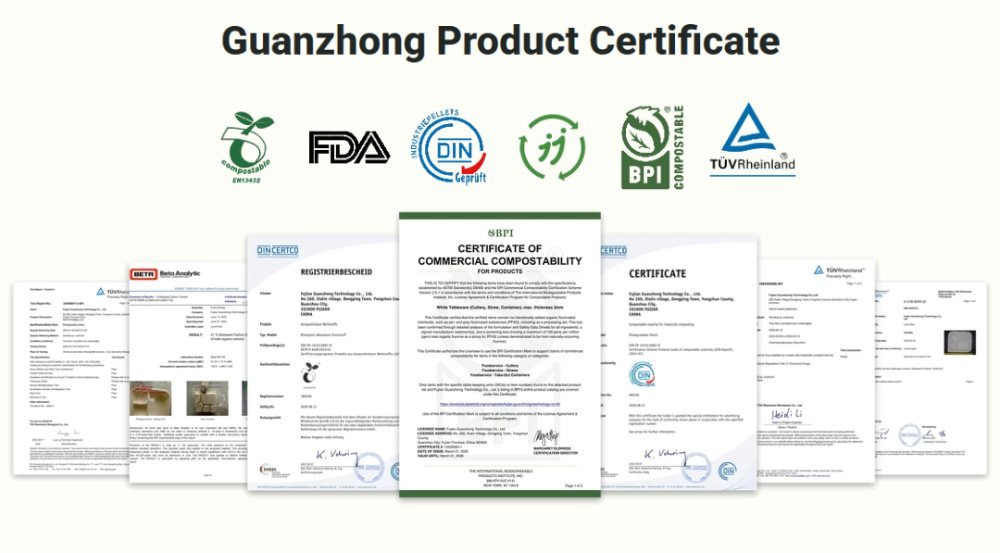
Global Environmental Regulations & Degradable Certifications
With the deep implementation of the EU SUP Directive (Single-Use Plastics Directive) and the rollout of environmental legislation across North American states, global catering and takeaway industry requirements for disposable tableware environmental compliance have reached unprecedented heights. Buyers must not only pay attention to product physical performance, but must also choose supply chain partners with internationally recognized qualifications.
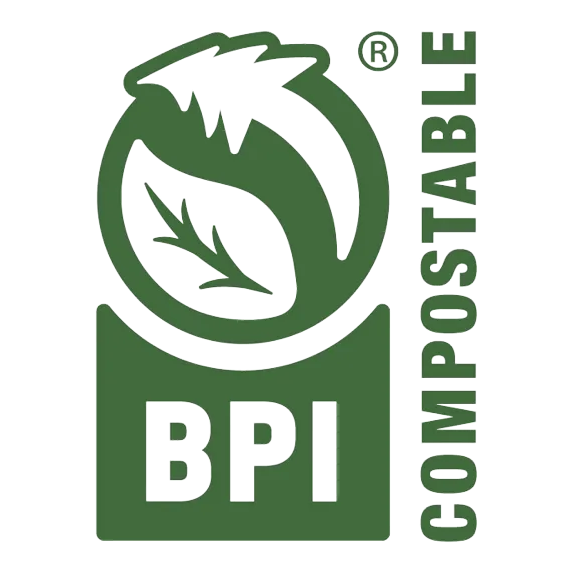
- BPI Commercial Compostability Certification: Complies with ASTM D6400 / D6868 industrial composting standards, guaranteeing products smoothly enter North American commercial composting systems.
- DIN CERTCO (EN 13432 / Seedling) Certification: Recognized by EU authoritative body DIN-Geprüft, verifying that products completely biodegrade within specified timeframes.
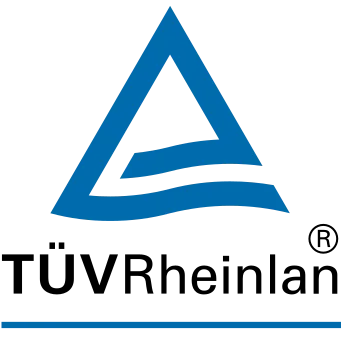
- FDA & TÜV Rheinland Safety & Quality Testing: Passed US FDA food-contact safety compliance and TÜV Rheinland certifications, ensuring zero toxic or harmful substance release.
- Beta Analytic Biobased Carbon Content Testing: Tested by authoritative third-party laboratories, scientifically quantifying the biobased carbon percentage of products.
In bento box disposable wholesale and disposable cutlery procurement, choosing a green supply chain with complete qualifications and self-developed modification capabilities is crucial. Utilizing bio-based and PLA biodegradable materials certified by BPI and EN 13432 can significantly reduce carbon footprint while perfectly preserving the processing performance and user experience of traditional plastics.
Guanzhong has always been committed to providing environmental solutions, holding 10+ technical patents, supporting global clients’ green transition from household items to catering tableware. The factory’s full line of biodegradable and bio-based products has earned multiple international authoritative certifications and test reports including BPI, DIN CERTCO, TÜV Rheinland, FDA, and Beta Analytic, helping brands easily navigate strict customs and market compliance audits worldwide.
Buyers should closely monitor the latest regulatory dynamics in target export markets, prioritizing connections with source factories possessing both scaled production capacity and multi-country compliance certifications to lay out biodegradable and bio-based product lines early and gain a competitive edge in intense global market competition.
💡 Frequently Asked Questions
Q: How can disposable biodegradable tableware meet environmental regulatory requirements in overseas markets like Europe and North America?
A: The key to meeting European and American compliance lies in material sources and certification systems. Buyers should select source factories utilizing PLA or bio-based modified materials, ensuring products contain no traditional non-degradable plastic components, and require factories to provide certificates and test reports issued by international authoritative organizations such as BPI (ASTM D6400), DIN CERTCO (EN 13432), TÜV Rheinland, and FDA to smoothly pass customs and market supervision reviews.
Ready to upgrade your disposable tableware supply chain quality?
Contact the Guanzhong expert team to receive exclusive OEM mold design solutions, PET/PP/PLA/bio-based material selection advice, and free product samples!
| Start Your Customization | WhatsApp: +86 13665956245 | Email: peters@quanzhong-bio.com |
Customizing high-quality disposable cutlery and food containers requires not only precise mold development and rational OEM structural design, but also scientific selection of PET, PP, PLA, or bio-based materials. Whether you are seeking long-term bento box disposable wholesale partnerships or comparing global disposable food packaging suppliers, partnering with Guanzhong—a powerful source factory featuring a 200,000-square-meter industrial park, a 90,000-ton annual capacity, 50 fully automated injection lines, and full international certifications including BPI / DIN CERTCO / FDA—will provide your brand with comprehensive tableware solutions balancing cost efficiency, quality assurance, and environmental compliance.