Key Takeaways
- Core Material Division of Labor: PP (Polypropylene) resists temperatures up to 120°C and oil/acids, making it ideal for hot food takeout and microwave heating; PET (Polyethylene Terephthalate) offers over 90% light transmittance and strong impact resistance for cold drinks and salads; PLA (Polylactic Acid) is plant-based with a germination time of 7-45 days under industrial composting, serving as the eco-friendly mainstay for plastic-ban markets.
- Scientific Material Selection Logic: Buyers should move beyond “lowest-price-only” thinking and evaluate food temperature, target market environmental regulations, and MOQ matching to prevent packaging deformation or compliance fines.
- Product Structure and Material Barriers: Guanzhong specializes in PET, PLA, PP, and bio-based composites (excluding paper and sugarcane products), utilizing 10+ patented technologies and leak-proof sealing to eliminate the softening, leaking, and brittleness of traditional alternatives.
- Source Manufacturing and Flexible Customization: Backed by a 200,000-square-meter industrial park, 100,000+ square meters of standardized workshops, and a 90,000-ton annual capacity, Guanzhong supports full-material customization starting at a 30,000-piece MOQ with 7-15 day fast delivery.
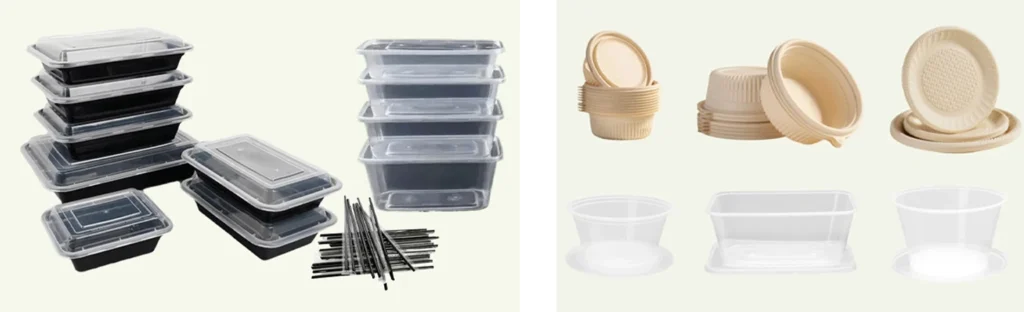
In food packaging procurement, the differences between PP, PET, and PLA mainly lie in heat resistance temperature, light transmittance, and biodegradation cycles. There is no absolute “all-purpose material,” only the solution that best matches specific food temperatures and environmental regulations. As disposable food container manufacturers deeply rooted in the industry, Guanzhong combines years of manufacturing and R&D experience serving global disposable food containers suppliers to deeply break down the underlying differences among these three mainstream polymer materials, helping you accurately avoid material selection pitfalls and reduce procurement and compliance costs.
Analysis of Basic Characteristics of PP, PET, and PLA
For brand owners and wholesalers looking for stable disposable food containers suppliers, understanding the molecular structures and raw material sources of PP, PET, and PLA is the first step in controlling product quality. Although these three materials sometimes look similar in appearance, their chemical properties and life cycles are completely different.
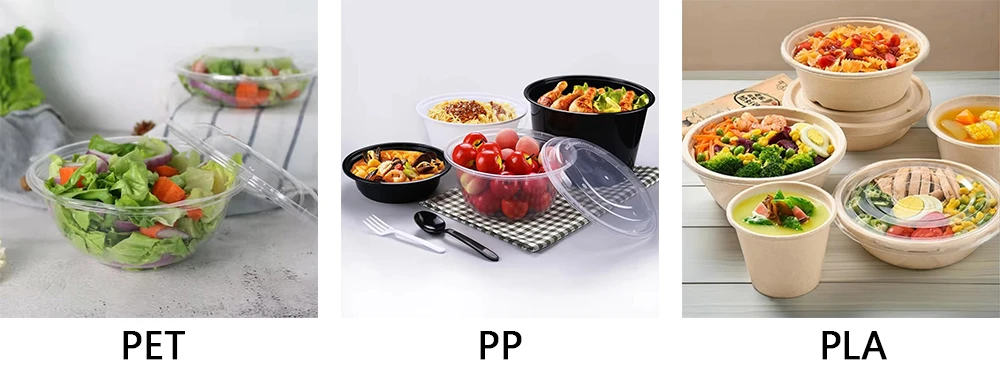
- PP (Polypropylene): A lightweight semi-crystalline thermoplastic (0.90–0.91 g/cm³) polymerized from propylene. Its stable chemical inertness prevents reactions with food oils or salts and withstands drastic temperature shifts, making it the global takeout standard.
- PET (Polyethylene Terephthalate): A high-crystallinity saturated polyester (1.38 g/cm³) featuring rigid benzene rings. This structure provides superior oxygen and moisture barriers alongside glass-like clarity, locking in the freshness and flavor of cold-chain foods.
- PLA (Polylactic Acid): A renewable bio-based plastic fermented and polymerized from corn or cassava starch. Per ASTM D6400 standards and Guanzhong’s R&D tracking, it decomposes completely into carbon dioxide and water under industrial composting, with a plant germination test cycle of 7-45 days.
In the game between environmental protection and performance, PP represents the pinnacle of traditional petrochemical-based materials in heat resistance and economy, PET represents the cold-chain standard of high barrier and high aesthetic appeal, while PLA and bio-based modified materials represent the core direction of global disposable food container manufacturers transitioning toward a low-carbon circular economy.
💡 Frequently Asked Questions
Q: What is the main difference between PP, PET, and PLA food containers?
A: PP is a heat-resistant plastic ideal for hot foods and microwave reheating, PET is a crystal-clear plastic best for cold drinks and salads, and PLA is a plant-based, biodegradable bioplastic designed for eco-friendly cold-to-warm food packaging.
In-Depth Comparison of Four Core Physical Properties
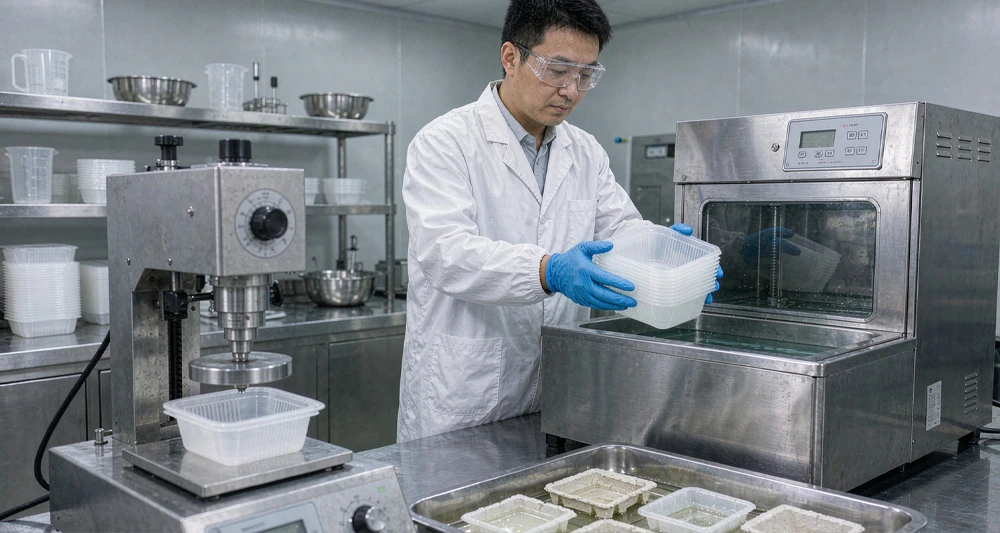
In actual commercial catering circulation, disposable food containers must not only hold food, but also withstand high-temperature filling, cold-chain transportation, long-distance bumps, and heavy oily soups. Relying on its internal R&D center and 10+ patented technologies, Guanzhong conducted strict quantitative evaluations of the three materials across four dimensions: heat resistance, transparency, impact resistance, and oil resistance.
| Core Performance Indicators | PP (Polypropylene) | PET (Polyester) | PLA (Polylactic Acid) | Guanzhong Modified Bio-Based Composite Material |
| Heat Resistance Temperature Range | -20°C to 120°C (Microwaveable) | -20°C to 60°C (Not microwaveable) | -10°C to 50°C (Standard grade) | -15°C to 85°C (Heat-resistant modified grade) |
| Optical Transparency | Translucent/Milky white (Light transmittance 60%-70%) | Extremely high transparency (Light transmittance >90%) | High transparency (Light transmittance approx. 88%) | Custom transparent or natural color (Formulated on demand) |
| Impact Resistance & Toughness | Excellent toughness, drop-resistant and unbreakable | Balanced rigidity and impact resistance, crush-resistant | Pure material is relatively brittle, prone to cracking at low temperatures | Toughened via masterbatch modification, impact resistance increased by 40%+ |
| Oil & Acid/Alkali Resistance | Extremely strong, non-swelling, leak-proof | Strong, resistant to weak acids and cold oils | Good, suitable for conventional cold meal oils | Strong, excellent resistance to oil penetration |
From the above laboratory and production line test data, we can extract three physical rules crucial to procurement decisions:
- Heat resistance determines microwave boundaries: Only PP stays structurally stable in 100°C boiling water and 120°C microwaves without releasing harmful substances. Standard PET and unmodified PLA soften above 60°C and must not be used for hot soup or reheating.
- Transparency drives terminal retail appeal: PET delivers crystal-clear 90%+ light transmittance that highlights fresh fruit and bakery colors, boosting impulse buys. Conversely, PP has a translucent matte finish better suited for practical hot soup bowls and takeout boxes.
- Modification technology overcomes pure PLA brittleness: Pure PLA is naturally brittle with low heat tolerance. Guanzhong uses 5 bio-based modified masterbatch lines and 3 biodegradable sheet extrusion lines to toughen PLA formulas, boosting impact resistance and heat limits to prevent transit breakage.
💡 Frequently Asked Questions
Q: Which disposable food container material has the best heat and oil resistance?
A: Polypropylene (PP) offers the highest heat resistance up to 120°C and superior oil resistance, making it the safest and most reliable choice for microwave reheating and greasy hot meals.
Container Material Matching for Different Catering Scenarios
Understanding material parameters is only the foundation; accurately matching the right material to specific catering business scenarios helps buyers maximize the commercial value of packaging. It is worth noting that Guanzhong focuses on high-molecular polymers (PET, PLA, PP) and bio-based/biodegradable composite materials (product lines do not include paper and sugarcane pulp products), completely avoiding the inherent defects of paper or plant-fiber meal boxes that easily soften and leak when holding soup, produce paper-pulp odors, and become damp and moldy.
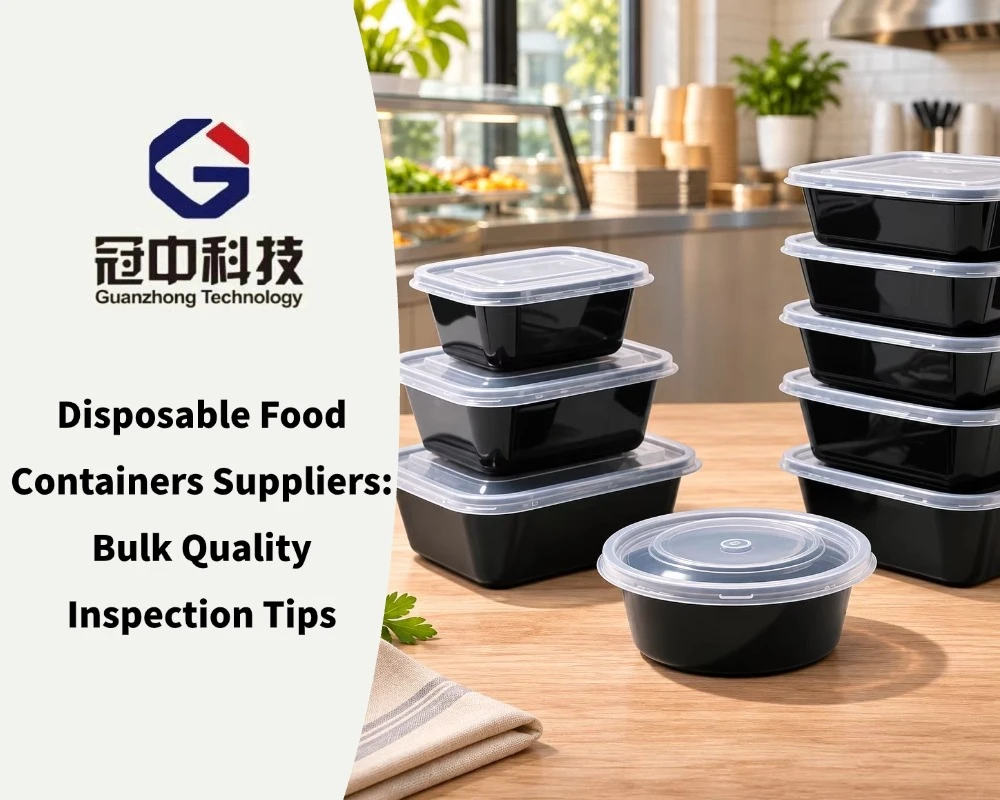
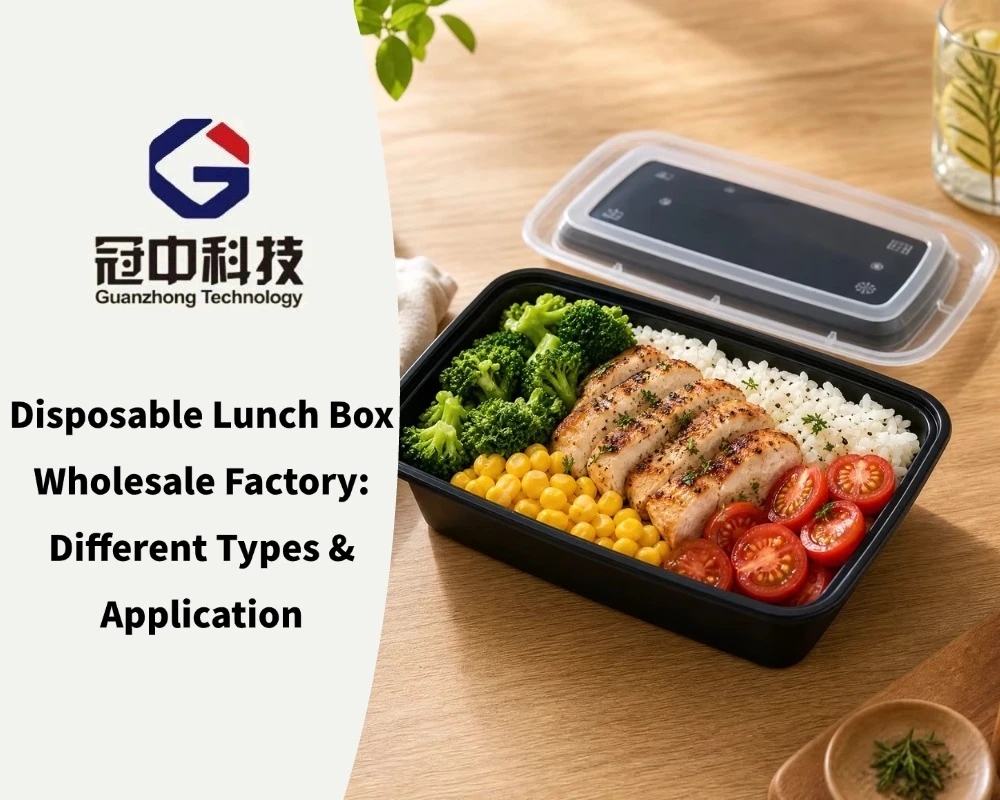
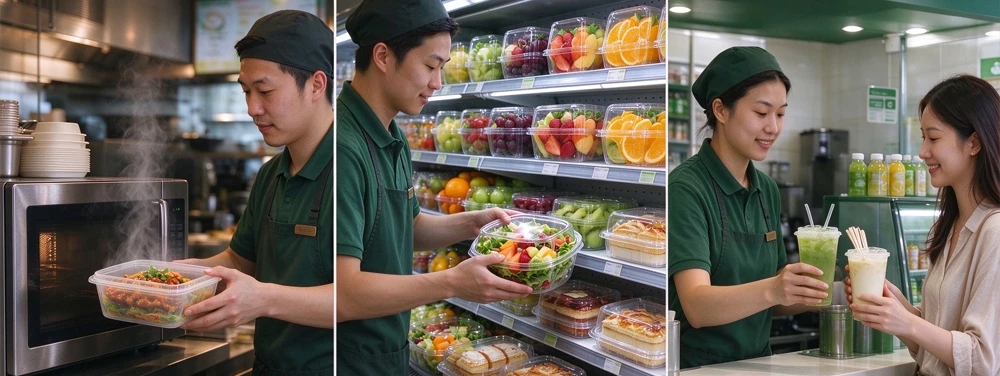
- Hot Food Takeout, Ready-to-Eat Meals & Microwave Fast Food — Injection-Molded PP: Ideal for spicy hot pot, stir-fries, and frozen pre-made meals. Food-grade virgin PP containers feature watertight lid buckles that hold hot oils without leaking, withstand -20°C freezing without cracking, and go straight into the microwave for reheating.
- Cold-Chain Fruit, Light Salads, Bakery & Cold Drinks — Thermoformed PET: Best for iced coffee cups, cake boxes, and fresh-cut fruit trays in convenience stores and supermarkets. High-precision thermoformed PET features smooth, burr-free edges, crystal-clear product visibility, and oxygen barriers that extend cold-chain shelf life by 1-2 days.
- Supermarkets, Airlines & Events in Plastic-Ban Markets — PLA & Bio-Based Composites: Designed for regions enforcing strict plastic bans like the EU (SUP Directive) and North America. Certified biodegradable PLA cold meal boxes, straws, and high-strength cutlery eliminate plastic tax risks while elevating your brand’s ESG eco-friendly image.
💡 Frequently Asked Questions
Q: Are PLA food containers suitable for hot soup or microwave use?
A: Standard PLA containers soften above 50°C and are best for cold or room-temperature foods, though modified heat-resistant bio-based composites can handle warm meals up to 85°C.
How Buyers Scientifically Select Container Materials
Faced with a complex international trade environment and diversified end-user demands, professional buyers and custom manufacturers should follow a standardized four-step decision-making framework before placing orders with disposable food container manufacturers to ensure every procurement dollar is well spent.
- Step 1: Lock in food filling and serving temperatures: Identify the highest contact temperature across the product lifecycle. Choose PP or heat-resistant modified bio-based materials for hot foods above 60°C or microwave use, and select PET or PLA for cold-chain and ambient foods (0°C–45°C).
- Step 2: Verify target market environmental regulations: Cost-effective PP and PET remain dominant in price-sensitive markets like Southeast Asia and the Middle East. For Europe, North America, Japan, South Korea, and Australia, verify local compostable certifications (EN 13432, ASTM D6400) early and prioritize PLA lines.
- Step 3: Evaluate custom MOQs and tooling costs: Avoid inventory backlogs by partnering with factories offering accessible customization thresholds. At Guanzhong, customized tableware and plates start at a low 30,000-piece MOQ, supporting custom logo printing, shapes, and sizes with minimal upfront capital risk.
- Step 4: Audit factory capacity reserves and lead times: Catering demand spikes sharply during holidays and peak seasons. Verify your disposable food containers suppliers possess sufficient line capacity and a fast 7-15 day production cycle to guarantee zero-stockout replenishment.
💡 Frequently Asked Questions
Q: How should wholesale buyers choose between PP, PET, and PLA suppliers?
A: Wholesale buyers should evaluate food serving temperatures, local plastic ban regulations, reasonable minimum order quantities (such as 30,000 pieces for custom items), and verify the manufacturer’s production lead time.
Guanzhong’s Full-Material Meal Box Customization and Manufacturing Advantages
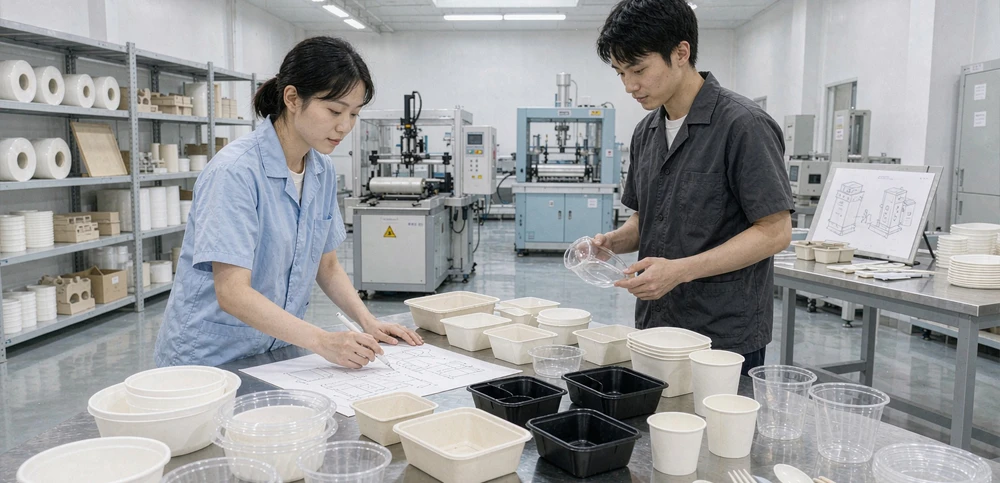
As disposable food container manufacturers directly serving global buyers, Guanzhong always puts product strength first. We deeply cultivate PET, PLA, PP, bio-based, and biodegradable composite materials (product lines do not include paper and sugarcane products). Relying on 10+ patented technologies and self-developed bio-based modification formulas, we have completely solved pain points such as traditional disposable tableware easily softening, leaking, cracking, and having strong odors, providing your terminal catering brand with visually appealing and highly reliable packaging products:
- Zero-Leakage, High-Sealing Precision Structure: Molded with high-precision tooling, Guanzhong containers feature tight-locking lids that prevent soup drips even when inverted, paired with smooth, burr-free edges and crush-resistant stackability for safe long-distance delivery.
- Polymer & Bio-Based Purity — Zero Paper-Pulp Odor or Softening: Unlike paper or sugarcane pulp boxes that absorb oil, soften, and emit odors, our food-grade virgin and modified bio-based products are completely odorless and oil-proof, with biodegradable lines achieving a 7-45 day compost germination time.
- High-Strength Cutlery Built for Hot & Cold Meals: Through proprietary bio-based toughening formulas, our PLA and bio-based knives, forks, and spoons deliver superior impact toughness and heat tolerance, staying rigid and smooth without snapping when cutting steaks or stirring hot dishes.
- Low-MOQ OEM/ODM Customization & Fast Delivery: We offer end-to-end customization for brand logos, multi-color printing, container shapes, and capacities starting at just 30,000 pieces, backed by a 90,000-ton annual capacity and a rapid 7-15 day production lead time.
💡 Frequently Asked Questions
Q: What are the main product advantages of Guanzhong’s disposable food containers and cutlery?
A: Guanzhong’s PP, PET, and PLA containers feature leak-proof sealing, superior oil and heat resistance, and zero paper-pulp odor, supported by custom logo printing, a 30,000-piece MOQ, and a fast 7-15 day production lead time.
Looking for a reliable source factory for your catering brand or wholesale business? Contact Guanzhong’s international business team immediately to apply for a free PP, PET, and PLA full-series material comparison sample kit, and obtain the latest product quotation catalog and one-on-one OEM/ODM customization solutions!
| Start Your Customization | WhatsApp: +86 13665956245 | Email: peters@quanzhong-bio.com |
Whether it is high-temperature and oil-resistant PP, crystal-clear and freshness-locking PET, or fully biodegradable PLA and bio-based composite materials representing a green future, every material plays an irreplaceable role in the modern catering supply chain. Only by deeply understanding their physical boundaries and partnering with disposable food container manufacturers possessing full-industry-chain R&D and large-scale delivery capabilities can you remain invincible amid fierce market competition and environmental regulations.
In the future, Guanzhong will continue to use its 200,000-square-meter industrial park and 90,000-ton annual production capacity as a solid foundation, continuously deepening innovation in polymer and bio-based materials, protecting the Earth’s green ecology with more eco-friendly, durable, and commercially valuable disposable tableware, food containers, and cutlery products, and helping global partners win broader market space.